How to Properly Prepare a Pipeline Surface Before Coating Application

No coating system can perform to its rated specifications on a poorly prepared surface. Surface preparation is not a cost to be minimized — it is the foundation upon which the entire service life of the coating depends. Industry data consistently shows that 70–80% of all premature coating failures are attributable to inadequate surface preparation rather than defects in the coating material itself.

Understanding Surface Cleanliness Standards

SSPC (Society for Protective Coatings) and NACE International have established a joint classification system for steel surface cleanliness that serves as the global benchmark. The most common standards applicable to pipeline coating are:

  • SSPC-SP 6 / NACE No. 3 (Commercial Blast): Removes all oil, grease, mill scale, and corrosion, leaving at most 33% coverage of staining per unit area. Adequate for immersion-grade epoxy and many polyurea systems.
  • SSPC-SP 10 / NACE No. 2 (Near-White Metal Blast): Removes at least 95% of all contaminants, leaving only light discoloration. Required for high-performance FBE and thin-film polyurea.
  • SSPC-SP 5 / NACE No. 1 (White Metal Blast): Complete removal of all visible rust, mill scale, and coatings. Specified for submerged and buried service in aggressive soils.

Blast Media Selection

Angular steel grit creates a higher anchor profile — measured in mils — than spherical shot, making it the preferred blast media for polyurea applications requiring anchor profiles of 2.5–4.5 mils. Aluminum oxide and garnet are non-recycled alternatives commonly used in field operations where contamination of the blast media is a concern.

Dew Point and Humidity Controls

Steel must be dry and above the dew point temperature before coating application. The standard requirement is that the steel surface temperature be at least 5°F above the dew point at all times during application and initial cure. Dehumidification tents are standard practice for buried pipeline field joint work in humid climates.

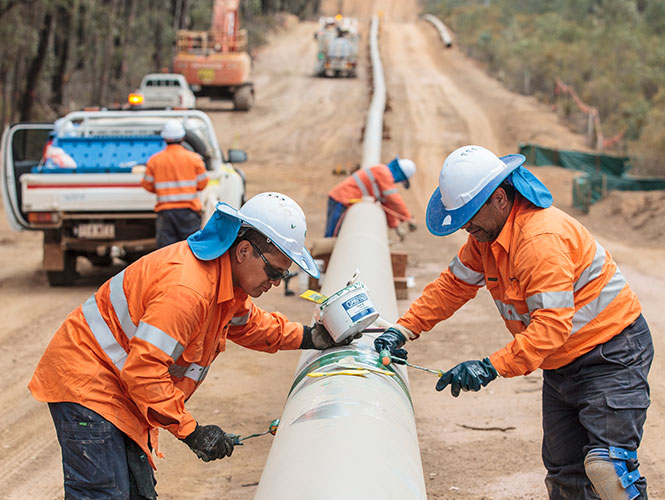
For a complete specification template covering surface preparation requirements for polyurea pipeline coatings, visit our resources library. You can also connect with certified applicators in your region who specialize in field preparation.

Read More

Industry News: PHMSA Announces Updated Pipeline Coating Standards for 2024

The Pipeline and Hazardous Materials Safety Administration (PHMSA) has issued a Notice of Proposed Rulemaking (NPRM) that would update coating performance requirements for onshore hazardous liquid pipelines under 49 CFR Part 195. The proposed changes reflect advances in coating technology and a decade of performance data collected under the current regime.

What’s Changing

The proposed rule would introduce minimum peel strength requirements, mandatory holiday testing procedures, and new specifications for field joint coating systems applied in trench conditions. It also proposes a performance-based pathway that allows operators to qualify novel coating materials — including spray polyurea and polyaspartic systems — through third-party testing rather than prescriptive specification compliance.

Industry Response

The oil pipeline coatings industry has broadly welcomed the performance-based pathway, noting that current prescriptive standards have struggled to keep pace with rapidly evolving materials chemistry. Several member organizations submitted comments highlighting their experiences with polyurea systems that meet or exceed the proposed performance benchmarks by wide margins.

Our organization submitted detailed technical comments to the PHMSA docket and will be presenting findings at the Annual Pipeline Integrity Summit in September. Members can access our full comment submission in the resources section.

Timeline and Next Steps

The comment period closes 90 days from the NPRM publication date. PHMSA has indicated a final rule could be published within 18–24 months. Operators are advised to begin reviewing their coating specifications and qualification programs now to ensure readiness for compliance.

Read More

The Science Behind Polyurea: Why It Outperforms Every Other Pipeline Coating

Polyurea is not just another coating — it is a chemically engineered material that has fundamentally changed the way pipeline operators think about asset protection. Born from the reaction between an isocyanate component and a synthetic resin blend, polyurea forms an elastomeric membrane that bonds tenaciously to steel, concrete, and virtually any properly prepared substrate.

The Chemistry That Makes It Work

When isocyanate reacts with an amine-terminated polyether or amine chain extender, the result is a urea linkage — giving polyurea its name and its extraordinary properties. Unlike polyurethane systems that require moisture to cure, pure polyurea systems are completely insensitive to humidity and temperature during the spray process, allowing application in conditions where other coatings would fail.

Key Performance Properties

  • Tensile strength: 2,000–4,500 psi depending on formulation
  • Elongation at break: 300–600%, allowing movement with the pipeline
  • Shore A hardness: 60–95, tunable for specific applications
  • Gel time: 3–5 seconds; walk-on time: <30 seconds
  • Temperature resistance: –40°F to +250°F continuous service
  • Chemical resistance: excellent against crude oil, refined products, brine, and hydrogen sulfide

Comparison With FBE and Epoxy

Fusion-bonded epoxy remains popular for new mainline pipe due to its thin film build and compatibility with directional drilling. However, polyurea surpasses FBE in field joint coating, rehabilitation, and any application requiring impact resistance or substrate movement tolerance. Our coating comparison guide breaks down the performance data across 12 key metrics.

Application Equipment and Technique

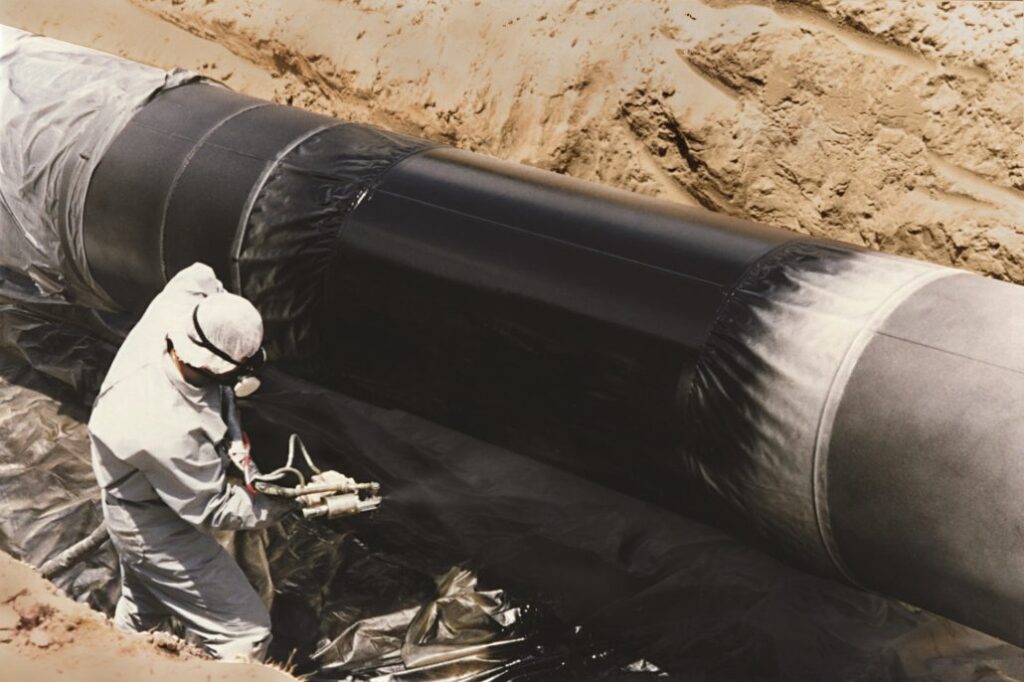
Proper application requires plural-component spray equipment operating at 2,000–3,000 psi with heated hoses maintaining 140–160°F. Plural-component systems from leading manufacturers keep the A and B components separated until they meet at the spray gun. Our certified applicator program provides hands-on training with industry-leading equipment.

Read More

Pipeline Corrosion Prevention: A Complete 2024 Industry Guide

Corrosion remains the single greatest threat to oil pipeline infrastructure worldwide, costing the industry an estimated $7 billion annually in repairs, downtime, and environmental remediation. Understanding modern corrosion prevention strategies is not just a technical necessity — it is a financial and environmental imperative for every pipeline operator.

What Causes Pipeline Corrosion?

Pipeline corrosion occurs when metal reacts with environmental factors including moisture, oxygen, soil chemistry, bacteria, and chemical contaminants. External corrosion affects the pipe’s outer surface due to soil contact and atmospheric exposure, while internal corrosion occurs from contact with transported fluids containing water, CO₂, H₂S, and organic acids. Both forms can lead to catastrophic failures if left unaddressed.

Types of Pipeline Corrosion

  • Uniform corrosion — consistent degradation across a surface, easier to detect and manage
  • Pitting corrosion — localized, deep pits that concentrate stress and are difficult to detect
  • Crevice corrosion — occurs in shielded areas like gaskets and flanges
  • Microbially Influenced Corrosion (MIC) — driven by sulfate-reducing bacteria in anaerobic soils
  • Stress Corrosion Cracking (SCC) — a combination of tensile stress and corrosive environment

Modern Coating Systems for Corrosion Prevention

The most effective front-line defense against pipeline corrosion is a high-performance coating system. Today’s leading solutions include polyurea coatings, fusion-bonded epoxy (FBE), three-layer polyethylene (3LPE), and polyaspartic systems. Each has unique advantages depending on operating conditions, substrate, and environmental exposure.

Polyurea has emerged as a premier choice for both new construction and pipeline rehabilitation due to its exceptional elongation, rapid cure time, and ability to bridge micro-cracks. Our members have consistently reported 30–40% longer service life when switching from traditional epoxy to polyurea-based systems.

Cathodic Protection Integration

Protective coatings work best when integrated with a robust cathodic protection (CP) system. CP suppresses the electrochemical reactions that drive corrosion by supplying electrons to the metal surface through either impressed current or sacrificial anodes. Industry standards including NACE SP0169 and ISO 15589 provide comprehensive guidelines for designing and maintaining CP systems alongside pipeline coatings.

Inspection Technologies

Smart pig (inline inspection tool) technologies, external corrosion direct assessment (ECDA), and digital twin modeling now allow operators to predict corrosion hotspots before failures occur. Combining these inspection regimes with high-performance coating systems creates a proactive maintenance culture that significantly reduces lifecycle costs. Learn more about our upcoming industry workshops on corrosion assessment techniques.

Standards and Compliance

Pipeline operators must comply with a complex matrix of standards including ASME B31.4, 49 CFR Part 195, ISO 21809, and regional environmental regulations. Our resources library contains downloadable compliance checklists, coating specification templates, and regulatory summaries to help your team stay current.

Read More