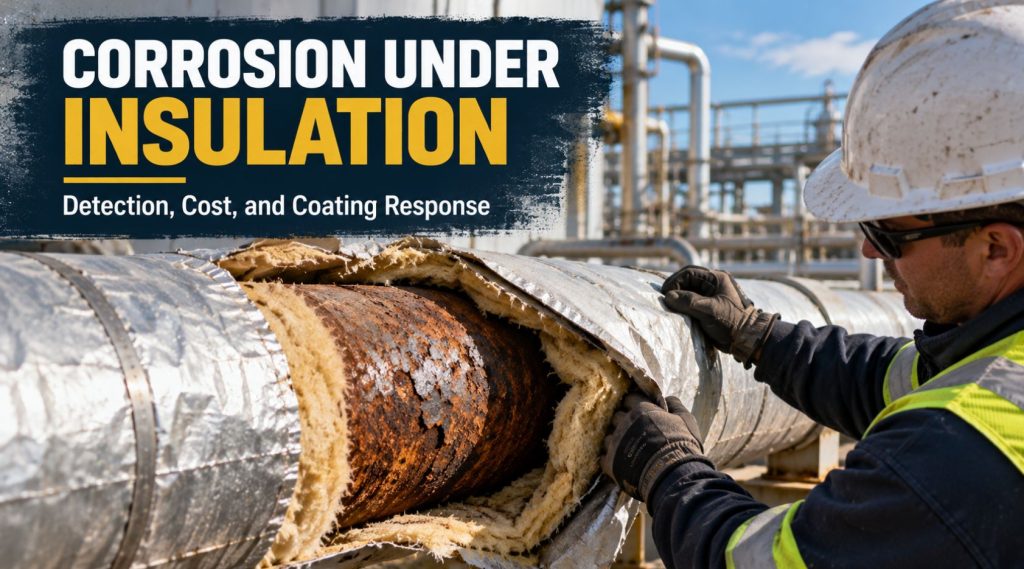
Corrosion Under Insulation: Detection, Cost, and Coating Response
There’s a particular kind of dread that comes with pulling insulation off a pipe that’s supposedly been fine for years and finding the wall thinned down to almost nothing underneath. Corrosion under insulation, usually just called CUI in the industry, earns its reputation as one of the most frustrating asset integrity problems in oil and gas specifically because it happens completely out of sight, often for years, while every visual inspection of the insulated exterior looks perfectly normal.
This piece gets into why CUI happens, why it’s so hard to catch early, what detection actually looks like in practice, and where coating strategy fits into managing a problem that a lot of operators only take seriously after it’s already cost them a shutdown or a near-miss.
Why Insulated Pipe Is Uniquely Vulnerable
Insulation exists to control temperature, keeping hot process lines hot and cold lines cold, and it does that job well. What it also does, almost as a side effect, is create a sealed, dark, often damp environment against the pipe wall that’s close to ideal for corrosion once moisture finds a way in. Rain, wash-down water, condensation from temperature cycling, or a failed vapor barrier can all introduce moisture under an insulation jacket, and once it’s in there, it tends to stay in there, held against the metal surface by the same jacketing that’s supposed to be protecting the pipe.
The temperature range that makes CUI worst isn’t the extremes you’d intuitively expect. Pipe operating consistently very hot tends to stay dry enough underneath that moisture doesn’t linger, and pipe running consistently well below freezing has its own separate set of problems but doesn’t typically see the same corrosion mechanism. It’s the range in between, roughly the band where water can exist as a liquid and cycle between wet and dry, that creates the most persistent corrosion risk. Equipment that cycles between operating and idle, or between different process temperatures, tends to be particularly susceptible, since that cycling actively promotes condensation rather than letting things stay reliably dry or reliably frozen.
Why It’s So Hard to Catch
A visual inspection of insulated piping tells you almost nothing about what’s happening underneath the jacket. The insulation and cladding look fine. The pipe could be fine too, or it could be losing wall thickness at a rate that will lead to a leak within a defined timeframe, and there’s no way to know which from the outside without actually doing something to look underneath or through the insulation.
This is exactly why CUI has a reputation for showing up as a surprise, even at facilities with otherwise solid inspection programs. A piping system might get a thorough external visual inspection every turnaround cycle, checks that catch plenty of real problems on uninsulated equipment, while insulated sections quietly deteriorate underneath jacketing that hasn’t been opened up in years because nothing about it looked concerning from outside.
What Actual Detection Looks Like
A handful of methods have become standard for finding CUI without simply removing every foot of insulation on a facility, which would be prohibitively expensive and disruptive.
Visual inspection with strategic insulation removal remains a baseline approach, focused on areas known to be higher risk, insulation seams, low points where water can collect, areas near penetrations or supports where jacketing is more likely to have failed.
Infrared thermography scans the insulation’s exterior surface for temperature anomalies that can indicate wet insulation underneath, since wet insulation typically has different thermal properties than dry insulation. It’s a useful screening tool for covering large areas relatively quickly, though it doesn’t directly measure corrosion, it flags areas worth a closer look.
Guided wave ultrasonic testing sends a sound wave along a length of pipe and analyzes the return signal for indications of wall loss, allowing inspection of a significant pipe length from a single access point without removing insulation along the entire run. It’s particularly useful for screening long insulated runs to prioritize where more detailed inspection is actually needed.
Real-time radiography and pulsed eddy current testing both allow direct measurement of pipe wall condition through the insulation without removal, each with different tradeoffs in terms of cost, speed, and the specific conditions they work best under.
No single method catches everything reliably on its own, which is why a serious CUI management program typically combines a risk-based approach, focusing detailed inspection resources on the piping most likely to have a problem, with a mix of these detection methods rather than relying on just one.
The Cost Side of the Problem
CUI has a well-documented reputation across the industry as one of the more expensive corrosion mechanisms to manage, not just because of the direct cost of failures when they happen, but because of how much it costs to inspect for proactively across a large facility with miles of insulated piping. Unplanned shutdowns from a CUI-related leak carry costs well beyond the repair itself, lost production, potential environmental or safety consequences, and the kind of reputational damage that follows a preventable failure becoming public.
This cost reality is part of why risk-based inspection approaches have become standard practice rather than trying to inspect every insulated pipe segment on an equal footing. Prioritizing based on known risk factors, operating temperature range, insulation condition, history of moisture ingress, age of the system, gets more value out of limited inspection budgets than a uniform approach would.
Where Coating Strategy Fits
Coating choice matters both for new construction and for CUI mitigation on existing systems, and the goals are somewhat different from typical external pipeline coating decisions covered elsewhere on this site. A coating intended to sit under insulation needs to handle sustained, cyclical moisture exposure in a confined space, along with the specific temperature range the equipment operates in, and ideally provide enough of a barrier that even if moisture does get past the insulation and jacketing, it doesn’t immediately start attacking bare metal.
Surface preparation before applying any CUI-resistant coating matters just as much here as it does for any other pipeline coating application, arguably more, since a coating failure under insulation won’t be visually obvious the way an external coating failure often is. Our guide on properly preparing a pipeline surface before coating covers preparation standards that apply directly to insulated piping systems as much as any exposed application.
It’s worth being clear that cathodic protection, a mainstay of buried pipeline corrosion control, generally doesn’t function the same way for insulated above-ground piping the way it does for buried systems, since CP relies on electrical continuity through the surrounding soil or water that insulated, above-grade piping doesn’t have. Our explainer on how cathodic protection interacts with pipeline coatings covers where CP genuinely applies and where a coating has to carry the corrosion protection burden on its own instead.
Building a CUI Management Program
Facilities that manage this problem well tend to treat it as an ongoing program rather than a one-time coating decision at construction. That means maintaining an accurate inventory of insulated piping with associated risk factors, scheduling risk-based inspection using the detection methods that fit each segment’s risk level and access constraints, and having a clear protocol for what happens once a problem area is found, whether that’s targeted insulation removal for closer inspection, recoating, or in more severe cases, pipe replacement.
Understanding why coatings fail in general terms helps inform what to watch for specifically in a CUI context too. Our root cause analysis of pipeline coating failures covers failure patterns that show up across pipeline coating applications broadly, many of which apply directly to why a coating under insulation might not be performing as expected. For the broader corrosion prevention picture that CUI fits into alongside other mechanisms, our complete guide to pipeline corrosion prevention covers the full toolkit operators draw from, coatings, cathodic protection, soil chemistry, and inspection technology working together rather than any single method carrying the whole burden.
Things to Consider for a CUI Program
- Has the facility’s insulated piping inventory actually been risk-ranked, or is inspection happening on a uniform schedule regardless of actual risk factors?
- Are detection methods matched to each segment’s access constraints and risk level, rather than defaulting to a single method across the whole facility?
- Has coating specification for insulated service actually accounted for the specific moisture and temperature cycling conditions, rather than reusing a standard external pipeline coating spec?
- Is there a documented protocol for what happens once a problem area is identified, so a finding doesn’t sit unaddressed while a decision gets made?
- Are insulation jacketing seals and vapor barriers being inspected and maintained, since preventing moisture ingress in the first place is at least as important as detecting corrosion after it’s already started?
Frequently Asked Questions
What temperature range is most susceptible to corrosion under insulation?
The range where moisture can exist as a liquid and cycle between wet and dry conditions tends to be the most problematic, rather than extreme high or low operating temperatures where conditions stay more consistently dry or frozen.
Can corrosion under insulation be detected without removing the insulation?
Yes, to a significant degree. Infrared thermography, guided wave ultrasonic testing, real-time radiography, and pulsed eddy current testing can all provide useful information without full insulation removal, though targeted removal for direct visual inspection is still often part of a complete program.
Does cathodic protection prevent corrosion under insulation?
Generally not for above-ground insulated piping, since cathodic protection relies on electrical continuity through soil or water that insulated, above-grade systems don’t have. Coating strategy carries more of the corrosion protection responsibility in these applications.
Why is corrosion under insulation considered so costly to manage?
Both the direct cost of failures, including unplanned shutdowns and potential safety or environmental consequences, and the cost of proactive inspection across large facilities with extensive insulated piping contribute to CUI’s reputation as an expensive corrosion mechanism to manage well.
How often should insulated piping be inspected for CUI?
It depends on risk factors specific to each piping segment, operating temperature range, insulation and jacketing condition, moisture exposure history, rather than a single fixed interval applied uniformly across a facility.
Conclusion
Corrosion under insulation is a genuinely difficult problem precisely because it hides so well, and facilities that treat it as an afterthought behind more visible corrosion concerns tend to find out the hard way that it doesn’t stay hidden forever. Building a real risk-based inspection program, choosing coating systems actually suited to the moisture and temperature conditions under insulation rather than reusing a standard external spec, and maintaining the insulation jacketing itself to keep moisture out in the first place are what separate facilities that manage this problem proactively from ones that discover it during an unplanned shutdown.
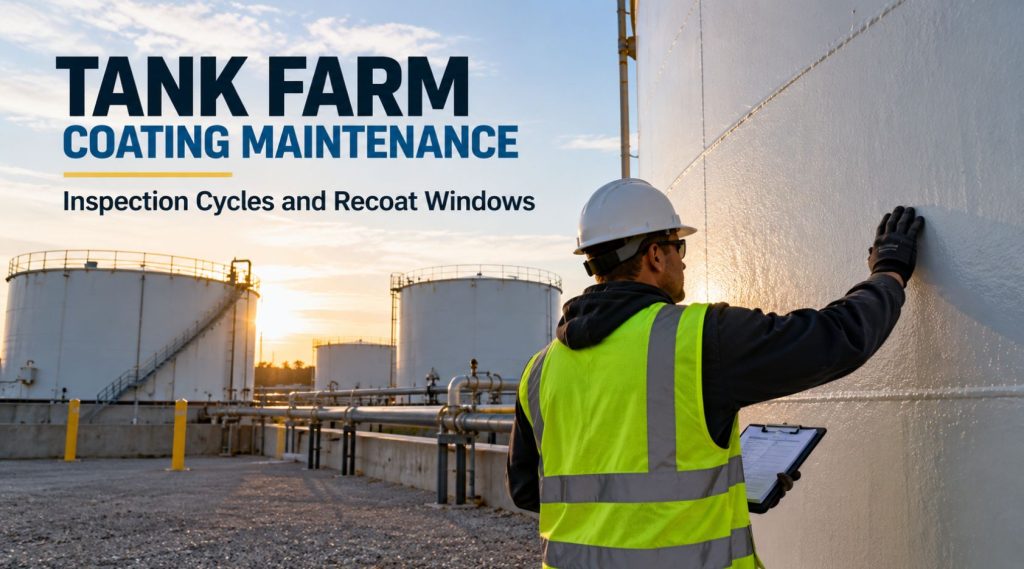
Tank Farm Coating Maintenance: Inspection Cycles and Recoat Windows
Tank farm coating maintenance is the ongoing program of inspection, condition assessment, and recoating that keeps tank shells, floors, roofs, and the surrounding containment structures protected against corrosion over decades of service. It’s a different discipline than new construction coating work. A new tank gets coated once, under controlled conditions, before it ever holds product. A tank that’s been in service for fifteen years gets coated under a completely different set of constraints: partial shutdowns, existing coating that has to be assessed and sometimes removed, and a decision every time about whether a section needs a full recoat or just a targeted repair. Getting that program right is what separates a tank farm that avoids surprise failures from one that’s constantly reacting to them.
What a Coating Maintenance Program Actually Covers
A tank farm isn’t one surface. It’s several, and each one ages differently. The exterior shell faces weather and UV exposure and typically gets a topcoat refresh well before the underlying system needs full replacement. The roof, especially on a cone or dome roof tank, sees standing water and thermal cycling that wears coatings faster than the vertical shell does. The internal lining, where product actually contacts the tank, deals with chemical exposure that varies enormously depending on what’s stored, from relatively benign refined products to more aggressive crude blends with higher water and sediment content. And the tank floor, sitting where water and sediment settle out of stored product, is often the first place internal corrosion shows up, which is exactly why floor coating and inspection get their own dedicated attention in most maintenance programs.
Then there’s everything around the tank itself: containment berms, interconnecting piping, and any secondary containment liner system, all of which need their own inspection and maintenance rhythm even though they’re not technically part of the tank.
Building an Inspection Cycle That Actually Catches Problems
Inspection frequency isn’t arbitrary. For aboveground storage tanks, API 653 sets the framework most operators use to determine internal inspection intervals, based on corrosion rate calculations tied to the tank’s minimum required thickness and the actual corrosion rate measured during the last inspection. A tank with a low measured corrosion rate might go fifteen or twenty years between internal inspections. A tank with active, faster corrosion gets inspected far more often, sometimes on a much shorter cycle if the numbers say so.
External visual inspection happens on a much tighter schedule than that, often annually or more frequently depending on the operator’s risk management approach. This is where a lot of coating problems get caught early: chalking, blistering, rust bleed at seams or fasteners, and general film breakdown are all visible from the outside without taking the tank out of service.
Risk-based inspection approaches have become more common across the industry, adjusting inspection frequency based on the actual consequence of a failure, not just a fixed calendar interval. A tank holding a relatively low-risk product in a location with minimal environmental sensitivity might reasonably be inspected less often than a tank holding something more hazardous in a location where a release would be far more consequential. The inspection cycle should reflect that risk picture, not just apply the same interval across every tank on the farm regardless of what’s actually at stake.
What Actually Triggers a Recoat
Not every coating defect means the whole tank needs to be stripped and recoated. Knowing the difference between a spot repair and a full recoat situation saves real money, but getting that call wrong in either direction creates its own problems.
A few signals tend to point toward a full recoat rather than a patch job. Widespread film breakdown across a large percentage of the surface, rather than isolated defects, usually means the coating system as a whole has reached the end of its useful life. Adhesion loss detected through testing, not just visible peeling, suggests the bond between coating and substrate has broken down more broadly than what’s visible on the surface. And coating age relative to the manufacturer’s expected service life matters too: a coating well past its rated life that’s showing any meaningful degradation is a different situation than a coating still well within its expected window with a single localized defect.
Holiday testing, checking for pinholes or thin spots using a high voltage spark tester on thicker coatings or a low voltage wet sponge method on thinner linings, is standard practice on internal linings before a tank goes back into service after any coating work. It catches defects that wouldn’t necessarily be visible otherwise, and a lining with widespread holidays across a large area is usually telling you the same thing as widespread visible film breakdown: the system needs full replacement, not spot repair.
Full Recoat vs. Spot Repair
| Factor | Spot Repair | Full Recoat |
|---|---|---|
| Extent of defects | Isolated, limited area | Widespread across the surface |
| Adhesion condition | Good in surrounding areas | Compromised broadly |
| Coating age vs. service life | Well within expected life | At or past expected service life |
| Cost | Lower, targeted | Higher, full surface preparation and application |
| Downtime | Minimal, often no shutdown needed | Often requires tank out of service |
| Long-term outlook | Buys time on an otherwise sound system | Resets the service life clock |
The decision usually comes down to whether the underlying coating system is still fundamentally sound with a few isolated problems, or whether the problems reflect a system that’s genuinely reached the end of its service life. Patching a tank that needs a full recoat just delays an inevitable, larger job, often at a point where the substrate has taken on more corrosion damage than it would have with a timely full recoat.
Standards and Regulatory Context
API 653 governs inspection, repair, alteration, and reconstruction of aboveground storage tanks and is the primary reference most operators work from for internal inspection intervals and repair criteria. Surface preparation for any recoat work should follow the applicable SSPC or NACE standard specified for the coating system being applied, and that standard should come from the coating manufacturer’s technical documentation for the specific product, not a generic assumption carried over from a different job.
Where a tank sits within a facility subject to SPCC requirements under 40 CFR 112, the condition of secondary containment around the tank is part of the same overall compliance picture, even though it’s a separate physical system from the tank coating itself. Our guide on well pad containment systems covers spray-applied, panel, and liner containment approaches in more depth, and a lot of the same inspection discipline that applies to tank coatings applies to the containment system surrounding it.
Coverage and Planning for Recoat Work
For spray-applied recoat systems, material planning follows the same basic coverage math used across the industry: one gallon spread at one mil thickness covers 1,604 square feet. Actual coverage for a specific recoat job depends on the dry film thickness specified for that coating system, which should come from the manufacturer’s technical data sheet rather than a generic assumption, particularly since recoat film builds sometimes differ from new construction specifications depending on the condition of the existing surface.
Recordkeeping and Tracking Coating History
A coating maintenance program is only as good as the records behind it. Every inspection should generate a documented record: coating condition ratings, film thickness readings, adhesion test results where applicable, photographs of any defects, and the specific findings that drove any repair or recoat decision. Without that history, each new inspection starts from scratch, and patterns that would otherwise be obvious over time, a section of tank that keeps failing early, a coating system that consistently underperforms its rated service life in a particular environment, go unnoticed.
Many operators managing larger tank farms have moved toward digital asset management systems that tie coating history directly to each tank’s inspection record, sometimes integrated with the broader mechanical integrity program covering the tank itself. That level of system isn’t necessary for every operation, but even a straightforward spreadsheet tracking coating type, application date, last inspection date, and condition findings per tank gives a maintenance program something to plan against instead of reacting to whatever surfaces during the next scheduled inspection. The goal either way is the same: turning individual inspection events into a continuous record that actually informs decisions, rather than treating each inspection as an isolated data point disconnected from the tank’s coating history.
Common Mistakes in Tank Farm Coating Programs
Deferring inspection to save near-term cost is probably the most common mistake, and it’s also the most expensive one over time. A corrosion problem caught early is a coating job. The same problem caught late can mean structural repair, and in the worst cases, a release.
Spot-repairing a system that actually needs full replacement is another recurring issue. It’s understandable why it happens: a spot repair is cheaper and faster in the moment. But when the underlying coating system has reached the end of its service life, repeated spot repairs on a failing system tend to cost more in cumulative labor and downtime than a single, well-planned full recoat would have.
Poor recordkeeping causes its own problems. Without a documented history of inspection findings, coating age, and past repair work, it’s hard to make a good data-driven decision about what a tank actually needs versus relying on whatever the inspector happens to notice that day. A tank farm with solid historical records can plan recoat work proactively. One without them ends up making reactive decisions under time pressure.
And mismatching a recoat product to the original system is a mistake that’s easy to make and expensive to fix. Not every coating chemistry is compatible with every existing substrate or prior coating layer, and applying an incompatible system can cause adhesion failure that shows up faster than the original coating problem did.
Frequently Asked Questions
How often should tank farm coatings be inspected?
External visual inspection typically happens annually or more often, while internal inspection intervals are generally set using API 653 corrosion rate calculations and can range from a few years to two decades depending on measured corrosion rates and tank service.
What’s the difference between a spot repair and a full recoat?
A spot repair addresses isolated defects on an otherwise sound coating system. A full recoat replaces the entire system, typically because degradation is widespread, adhesion has broadly failed, or the coating has reached the end of its expected service life.
What is API 653 and why does it matter for coating maintenance?
API 653 is the industry standard governing inspection, repair, alteration, and reconstruction of aboveground storage tanks. It’s the primary reference for setting internal inspection intervals based on corrosion rate and tank condition.
Can a tank stay in service during coating maintenance?
External shell and roof work can often be done with the tank in service, depending on the scope. Internal lining work, including most floor recoating, generally requires the tank to be taken out of service and properly cleaned and vented first.
How long does a tank coating typically last before it needs a recoat?
This depends heavily on the specific coating system, the product stored, and environmental exposure. The manufacturer’s technical documentation for the specific coating gives the expected service life, and actual condition at inspection should always take priority over a generic assumption based on age alone.
Who typically manages a tank farm coating maintenance program?
It’s usually a shared responsibility between the facility’s mechanical integrity or asset management team, who track inspection schedules and regulatory compliance, and the coating contractor or applicator brought in for the actual assessment and recoat work. Larger operations often have an internal coordinator whose job is specifically to keep the inspection calendar, recordkeeping, and contractor scheduling aligned across every tank on the site.
Conclusion
A tank farm coating maintenance program that actually works isn’t built around a single fixed schedule applied to every tank the same way. It’s built around inspection intervals grounded in real corrosion data, a clear framework for deciding when a spot repair is enough versus when a full recoat is the right call, and consistent recordkeeping that turns each inspection into useful data for the next one. Operators who treat coating maintenance as an ongoing program rather than a reactive response to visible problems consistently spend less over the life of a tank farm, and they avoid the kind of surprise failures that cost far more than the maintenance program ever would have.
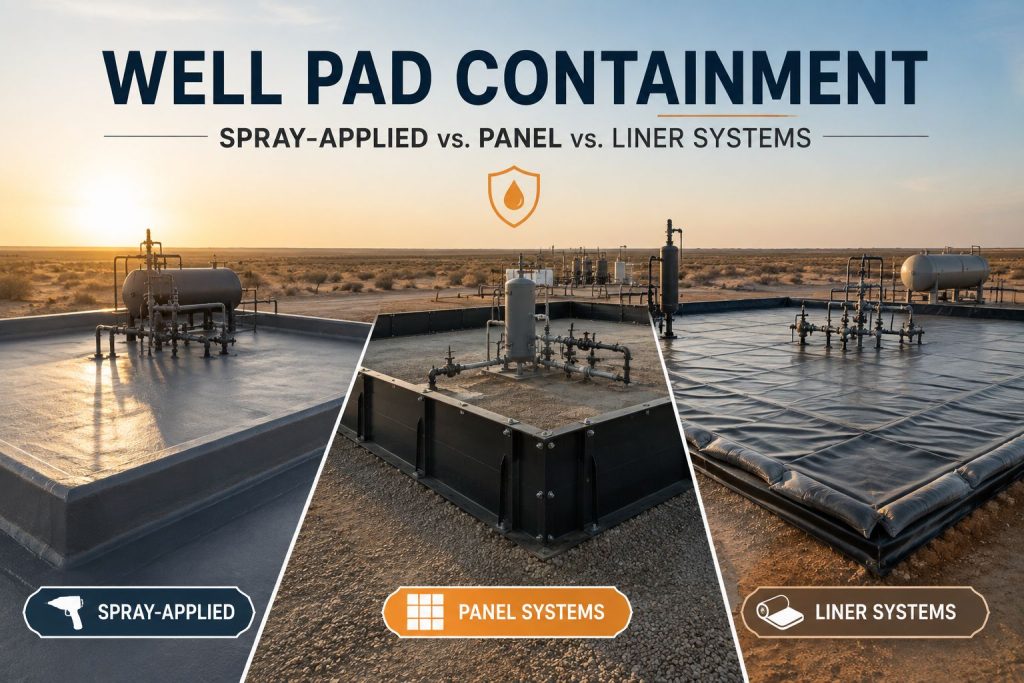
Well Pad Containment: Spray-Applied vs. Panel and Liner Systems
Well pad containment exists to keep a spill where it happens instead of letting it migrate into surrounding soil or groundwater, and the system chosen to do that job has real consequences for both regulatory compliance and long-term site risk. Operators generally choose between three broad approaches: spray-applied liner systems, prefabricated panel systems, and sheet liner systems built from HDPE or similar geomembrane material. Each one handles the same basic job differently, with real tradeoffs in installation speed, seam integrity, mobility, and cost. This guide breaks down how each system works, where it tends to perform best, and what to weigh before specifying one for a given site.
Understanding the Basics
Well pad containment typically covers the area around wellheads, tank batteries, separators, and other equipment where a leak or spill could otherwise reach bare soil. The containment system’s job is to hold that liquid within a defined area, whether through a lined berm, a sealed pad surface, or a combination of both, until it can be recovered or properly managed.
Spray-applied systems, most commonly polyurea, are applied directly to a prepared pad surface or berm structure as a liquid that cures into a seamless, continuous membrane. Because the coating is sprayed rather than pieced together, it conforms to irregular grading, corners, and penetrations without the seams that other systems require.
Panel systems use prefabricated, often modular sections, typically fiberglass or coated steel, that interlock or bolt together on site to form a containment perimeter. They are designed to be assembled and disassembled relatively quickly, which makes them a common choice for temporary or relocatable containment needs.
Liner systems use large sheets of HDPE or other geomembrane material, field-seamed together and anchored or ballasted in place to cover the pad area. This is one of the most widely used approaches across the industry, largely because of its lower material cost relative to the surface area it covers.
Well Pad Containment: Key Differences Between the Three System Types
Seams and failure points. Spray-applied containment cures as a continuous, seamless membrane, which removes the seam-related failure points that panel and liner systems have to manage carefully. Panel systems rely on interlocking joints or gaskets between sections. Liner systems depend on field-welded or taped seams between sheets, and seam quality is one of the most common sources of liner failure when installation isn’t done carefully.
Conformity to terrain. Spray-applied systems conform closely to irregular grading, slopes, and penetrations around equipment, since the material is applied directly to the prepared surface. Panel and liner systems generally work best on flatter, more uniform pad areas, and irregular terrain can complicate installation and increase the risk of gaps or improper fit.
Installation speed. Panel systems are often the fastest to assemble and disassemble, which is part of why they’re common on temporary drilling-phase sites. Spray-applied systems can also move quickly once the substrate is properly prepped, with cure times that allow a fast return to service. Liner installation speed depends heavily on pad size and the number of field seams required.
Mobility and reuse. Panel systems are generally the most relocatable option, designed to be broken down and moved to another pad. Liner systems can sometimes be lifted and reused if undamaged, though this depends on the specific material and how it was anchored. Spray-applied systems are a permanent, bonded installation and are not designed to be relocated.
Puncture and mechanical damage resistance. Liner systems, particularly thinner geomembrane sheets, are more vulnerable to punctures from underlying rock, sharp debris, or equipment traffic unless properly protected with a cushioning layer. Spray-applied coatings bonded to a properly prepared substrate generally hold up better against point loading and minor mechanical impact.
Maintenance and inspection. Seamless spray-applied systems are generally easier to inspect visually since there are no seam lines to check individually. Panel and liner systems require more attention to joints, seams, and anchor points during routine inspection.
Cost. Liner systems typically carry the lowest material cost per square foot for large flat areas. Panel systems and spray-applied systems generally cost more upfront, though the right comparison depends on installation labor, site conditions, and whether the containment is intended as permanent or temporary.
Comparison Table
| Factor | Spray-Applied | Panel Systems | Liner Systems |
|---|---|---|---|
| Seams | None, continuous membrane | Interlocking joints | Field-welded or taped seams |
| Terrain conformity | High, follows grading and penetrations | Best on flat, uniform areas | Best on flat, uniform areas |
| Installation speed | Fast once substrate is prepped | Generally fastest to assemble | Depends on pad size and seam count |
| Mobility | Permanent, not relocatable | Highly relocatable | Sometimes reusable if undamaged |
| Puncture resistance | Strong when properly bonded | Moderate, depends on panel material | More vulnerable without cushioning |
| Typical use | Permanent installations, irregular grading | Temporary or drilling-phase sites | Large flat pad areas, budget-driven projects |
| Typical cost | Higher | Moderate to higher | Generally lowest per square foot |
Best Use Cases
Spray-applied containment tends to make the most sense for permanent well pad installations, sites with irregular grading or numerous equipment penetrations, and situations where long-term seam integrity is a priority. Because it conforms directly to the prepared surface, it also reduces the risk of gaps that can develop around complex equipment layouts. For more on how spray-applied polyurea performs in pipeline-adjacent applications, our guide on why polyurea has become the go-to pipeline coating covers the underlying chemistry and performance considerations in more detail.
Panel systems fit well on temporary or drilling-phase sites where the containment needs to be assembled quickly, potentially disassembled, and moved to the next location as operations progress. Their modularity is the main advantage here, at some cost to long-term seam durability compared with a bonded system.
Liner systems remain a common, cost-effective choice for large, relatively flat pad areas where budget is a primary constraint and the site doesn’t present significant terrain or penetration challenges. For a closer look at how liner materials compare on broader technical grounds, our HDPE versus polyurea coating comparison walks through the tradeoffs in more depth.
Things to Consider Before Choosing
Confirm the regulatory containment volume requirement first. Federal and state secondary containment requirements, including relevant SPCC and state E&P regulations, typically specify a minimum containment volume based on tank or equipment capacity. Whatever system is chosen needs to meet that volume requirement, not just cover the ground area.
Assess the pad’s terrain and equipment layout. A pad with significant grading, multiple penetrations, or an irregular footprint favors a system that can conform to that complexity without relying on multiple seams or field-cut sections.
Factor in whether the containment is permanent or temporary. A site expected to operate for years favors a durable, low-maintenance system. A drilling-phase site with a short operational window may be better served by a relocatable panel system that doesn’t require the same long-term investment.
Plan for surface preparation regardless of system type. Spray-applied coatings depend heavily on proper substrate prep. Liner systems need a stable, debris-free base and often a cushioning layer to prevent punctures. Neither system performs to its potential over an inadequately prepared pad surface. Surface prep failures are the leading cause of coating problems across pipeline and containment applications alike, which our guide on pipeline surface preparation covers in more detail, even though it’s written primarily for linear pipeline projects rather than pad containment specifically.
Ask about seam quality control on any liner or panel installation. If a liner or panel system is selected, ask how seam welds or joints are tested, whether that’s vacuum box testing, air lance, or another method, since seam integrity is where most containment failures in these systems originate.
Common Mistakes in Well Pad Containment Installation
Underestimating the required containment volume. Sizing a system to the visible footprint of the tanks rather than the actual regulatory volume requirement is a common shortfall. The containment area and depth both factor into whether the system actually meets the applicable standard, not just the ground area it covers.
Skipping subgrade preparation to save time. Whether the system is spray-applied, paneled, or lined, an inadequately compacted or debris-strewn subgrade undermines the installation from the start. Rushing this step to get equipment operational faster tends to show up later as premature failures.
Treating penetrations as an afterthought. Wellheads, piping, and equipment stands that penetrate the containment area are common weak points if they aren’t properly detailed during installation. This is one area where seamless spray-applied systems have a real advantage, since there’s no seam to manage around an irregular penetration.
Underestimating wind and weather exposure for liner systems. Liner systems that aren’t properly anchored or ballasted can shift or billow in high wind, which stresses seams and anchor points over time. Site-specific wind exposure should factor into the anchoring plan, not just a generic installation standard.
Deferring inspection until a problem is visible. By the time a containment failure is visible at the surface, contamination may have already occurred. A routine inspection schedule, rather than a reactive one, catches most issues while they’re still a minor repair.
Coverage and Planning
For spray-applied systems, coverage follows the standard film-build math: one gallon spread at one mil thickness covers 1,604 square feet. Actual material requirements depend on the specified dry film thickness for the containment application, which should be based on the manufacturer’s technical data sheet and the containment volume and durability requirements for the specific site, not a generic assumption.
Maintenance
All three system types benefit from a routine inspection schedule, though what gets inspected differs. Spray-applied systems should be checked for UV-related surface wear, mechanical damage from equipment traffic, and any signs of substrate movement telegraphing through the coating. Panel systems need joint and gasket inspection to confirm seals remain intact after assembly, disassembly, or relocation. Liner systems require seam inspection along with checks for punctures, UV degradation on exposed material, and anchor or ballast integrity, particularly after high wind events. Any damage identified during inspection should be addressed promptly, since a small breach in any of these systems defeats the purpose of the containment.
Frequently Asked Questions
Which well pad containment system lasts the longest?
This depends on the specific product, installation quality, and site conditions rather than the category alone. A well-installed spray-applied system and a well-installed liner system can both perform for years, while a poorly installed version of either can fail early.
Can panel systems be reused on multiple well pads?
Often, yes, which is one of their main advantages for operators running multiple temporary sites. Condition should be assessed before each redeployment to confirm joints and panels haven’t been damaged.
Do liner systems need a cushioning layer underneath?
In many cases, yes, particularly on pads with rocky or uneven subgrade, to reduce the risk of puncture from underlying material.
Is spray-applied containment more expensive than a liner system?
Generally, yes, on a material cost basis, though the comparison should account for installation labor, expected service life, and maintenance needs rather than material cost alone.
How is the required containment volume determined?
It’s generally based on the capacity of the tanks or equipment being contained, per applicable federal and state secondary containment regulations. This should be confirmed with the specific regulatory requirements that apply to the site before selecting a system.
Conclusion
Spray-applied, panel, and liner systems all serve the same core purpose on a well pad, but they get there differently, and the right choice depends on the pad’s terrain, whether the containment is permanent or temporary, budget, and the regulatory volume requirement that has to be met. Seamless spray-applied systems tend to suit complex, permanent sites best. Panel systems fit temporary, relocatable operations. Liner systems remain a practical, cost-effective option for large, flat pads. Matching the system to the site’s actual conditions, rather than defaulting to whichever option is most familiar, is what determines whether the containment holds up when it’s actually needed.
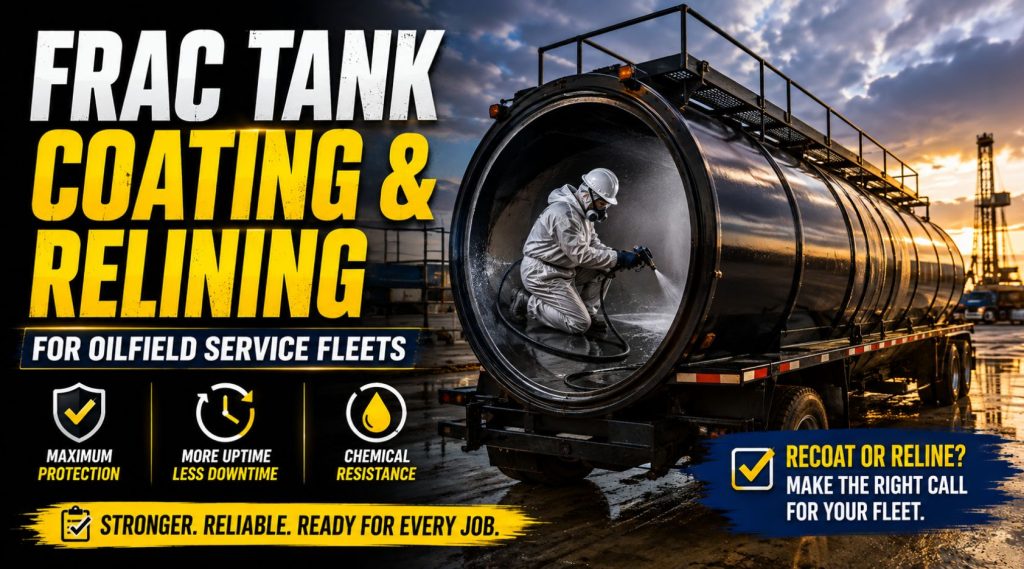
Frac Tank Coating and Relining for Oilfield Service Fleets
A frac tank earns its keep by moving between sites, holding whatever fluid the job requires, and getting back on the road. That work cycle is hard on a coating in a way stationary infrastructure isn’t. Constant fluid exposure, frequent cleanout, road vibration, and weather extremes all wear on a tank’s interior and exterior finish faster than most fleet operators expect.
This guide looks at what actually drives frac tank coating decisions, when a recoat is enough versus when a full reline is the better call, and what to weigh when specifying protection for a fleet that needs to stay in rotation rather than sit idle for a lengthy rehab job.
Understanding the Basics
Frac tanks used in oilfield service see a wider range of chemical exposure than most fixed storage vessels, since the same tank might hold produced water, fracturing fluid, acid, or fresh water depending on the job. That variability is the starting point for any coating decision, since a coating suited to one fluid type may perform poorly against another.
Two separate surfaces need consideration: the interior, which sees direct fluid contact and needs chemical resistance above almost everything else, and the exterior, which faces road wear, UV exposure, and the general abuse of being hauled between sites. Treating both as the same coating decision is a common mistake. They often call for different specifications.
Why Frac Tanks Wear Faster Than Fixed Tanks
A stationary storage tank might see one fluid type for years. A frac tank in active fleet rotation can cycle through multiple fluid types in a single month, with cleanout and re-fill happening on a tight turnaround between jobs. That cycling stresses a coating in ways a single-exposure application doesn’t, since chemical compatibility, thermal cycling, and mechanical wear from cleanout procedures all compound over a shorter timeframe.
Road transport adds another layer of stress that fixed tanks don’t face at all. Vibration, minor impacts, and repeated loading and unloading all contribute to coating wear on the exterior and at structural stress points, which is part of why fleet-use tanks often need more frequent inspection than their fixed counterparts.
Recoat vs. Reline: What’s the Difference
These two terms get used loosely in the field, but they describe different scopes of work.
A recoat typically means addressing surface-level wear, applying a fresh coating layer over a substrate that’s still structurally sound and doesn’t have significant coating failure or exposed metal beyond isolated spots. It’s a faster, lower-cost intervention aimed at extending the life of an otherwise serviceable tank.
A reline is a more complete process, usually involving full removal of the failing coating, inspection and repair of the underlying substrate, and application of a new coating system from bare or properly prepared metal. Relining is called for when coating failure is widespread, when there’s evidence of underlying corrosion, or when a tank is being repurposed for a fluid type its original coating wasn’t rated for.
Choosing between the two starts with an honest inspection rather than a default toward the cheaper option. A recoat applied over a substrate with hidden corrosion or extensive delamination often fails faster than expected, turning a cost-saving move into a repeat expense.
Chemical Compatibility Considerations
Because frac tanks in fleet service may hold different fluids across their working life, chemical compatibility deserves more attention than it typically gets in a routine recoat decision. A coating rated for produced water exposure may not hold up the same way against acid or certain fracturing fluid additives, and assuming a coating that performed well historically will continue to perform well under a new fluid type is a common and costly mistake.
Reviewing what the tank has been used for, and what it’s likely to be used for going forward, before specifying a coating or relining system is a basic step that gets skipped more often than it should, usually under schedule pressure.
Fleet Logistics and Downtime
Unlike fixed infrastructure, a frac tank sitting out of rotation for coating work is a tank not earning revenue. This makes turnaround time a real factor in the coating decision, not just a nice-to-have. Faster-curing coating systems can reduce the number of days a tank sits out of service, which matters more to a fleet operator managing dozens of tanks than it might to an owner of a single fixed asset.
Scheduling coating work in batches, rather than pulling tanks one at a time as problems surface, is a common way fleet operators reduce the cumulative downtime cost of maintaining a coating program across an entire fleet.
Recoat vs. Reline Comparison
| Factor | Recoat | Reline |
|---|---|---|
| Scope | Surface-level coating renewal | Full coating removal and substrate repair |
| Best for | Tanks with isolated wear, no major corrosion | Tanks with widespread failure or corrosion |
| Downtime | Shorter | Longer |
| Cost | Lower upfront | Higher upfront |
| Long-term risk | Higher if underlying issues are missed | Lower, since substrate is fully inspected |
| Fluid compatibility check | Recommended before proceeding | Essential, especially if service use is changing |
Things to Consider Before Coating or Relining a Frac Tank
- What fluid types has this tank held, and what will it likely hold going forward?
- Is the existing coating failure isolated, or does inspection suggest wider substrate damage?
- How much downtime can the fleet actually absorb for this tank right now?
- Does the coating or relining contractor have documented experience with oilfield service fleet tanks specifically, not just fixed storage vessels?
- What’s the inspection and maintenance plan after the work is done, so problems get caught early rather than during the next fluid changeover?
Surface preparation quality matters as much here as it does on any other pipeline or tank coating project. Our guide on properly preparing a surface before coating covers the standards that apply broadly across oilfield coating work, not just pipelines.
Maintenance and Inspection
A fleet-use frac tank benefits from a more frequent inspection schedule than a fixed tank, given the wear pattern described above. Checking the interior after cleanout, before refilling with a new fluid type, is one of the more effective habits a fleet operator can build into a maintenance routine, since it catches coating wear before it becomes a bigger problem. Exterior inspection after transport, particularly around structural connection points and areas prone to impact, is worth the same regular attention.
Understanding why coatings fail in the first place helps prioritize what to inspect for. Our root cause analysis of pipeline and tank coating failures breaks down the most common failure patterns, most of which trace back to surface preparation or chemical incompatibility rather than the coating material itself.
Frequently Asked Questions
How often should a frac tank be recoated?
There’s no fixed universal interval. It depends on fluid exposure history, cycling frequency, and inspection findings rather than a calendar schedule alone. Regular inspection is more reliable than assuming a fixed timeframe.
Can one coating system handle every fluid a frac tank might carry?
Not necessarily. Chemical compatibility varies by coating formulation, and a tank that regularly changes service fluids needs a coating specified with that variability in mind rather than for a single fluid type.
Is relining always more expensive than recoating?
Upfront, yes, since it involves more labor and material. But a recoat applied over hidden substrate damage can lead to earlier failure and repeat costs, so total cost of ownership sometimes favors relining even when the initial price is higher.
What coating types are typically used for frac tank interiors and exteriors?
Several coating categories see use in this application, including various spray-applied systems, chosen based on the fluid exposure and service conditions. For a broader look at how different coating systems compare, see our comparison of pipeline coating types.
Does exterior coating matter as much as interior lining for a frac tank?
Both matter, but for different reasons. Interior coating deals with chemical exposure directly. Exterior coating protects against road wear, weather, and corrosion from ongoing transport and handling, and neglecting it can eventually compromise the structure supporting the interior lining.
Conclusion
Frac tanks in oilfield fleet service face a wear pattern that fixed storage tanks simply don’t, and treating them the same way for coating and maintenance planning tends to lead to premature failures and unplanned downtime. Deciding between a recoat and a full reline comes down to an honest substrate inspection, a clear picture of past and future fluid exposure, and how much downtime the fleet can realistically absorb. Building a regular inspection habit into the fleet’s operating routine remains the most reliable way to catch coating problems while a simple recoat is still an option, rather than after the situation has escalated to a full reline.
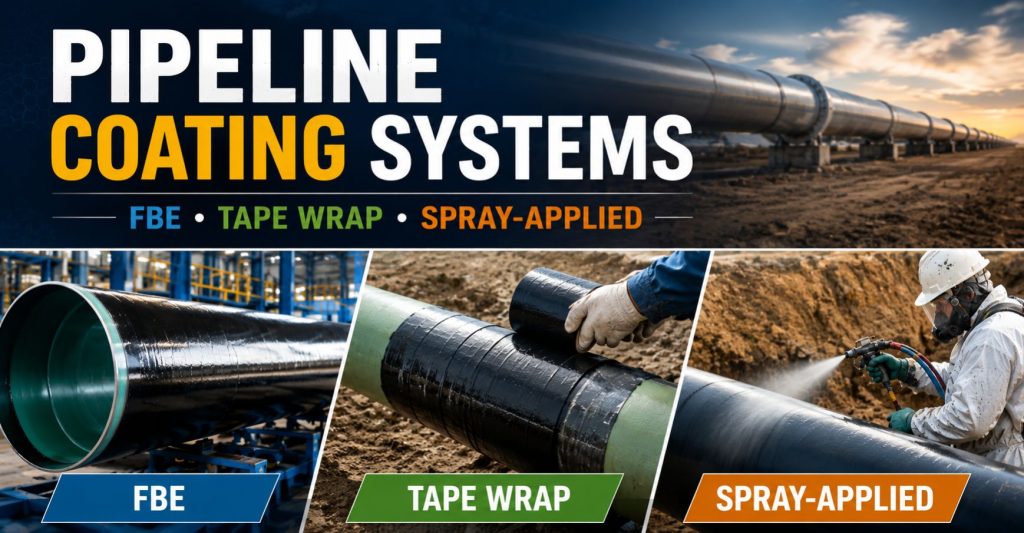
Pipeline Coating Systems Compared: FBE, Tape, and Spray-Applied
Choosing a pipeline coating system usually comes down to three broad categories: fusion bonded epoxy, tape wrap systems, and spray-applied coatings. Each has a long track record in the industry, and each fits a different mix of project conditions, from mainline new construction to field joint repair to rehabilitation work on aging infrastructure.
This guide compares the three at a practical level, covering how each is applied, where it tends to perform well, and what tradeoffs come with it, so the choice can be based on project conditions rather than whichever option a given contractor happens to default to.
Pipeline Coating Systems Compared: Understanding the Basics
All three coating categories exist to do the same core job: create a barrier between the pipe’s steel surface and the surrounding soil, water, or atmosphere, reducing corrosion risk and extending service life. How they achieve that barrier, and where in the pipeline lifecycle they’re typically applied, is what separates them.
Fusion bonded epoxy (FBE) is a factory-applied, heat-cured thin-film coating, most commonly used on new mainline pipe before it ever reaches the field. Tape wrap systems, whether cold-applied or hot-applied, are mechanically wrapped around the pipe, often used for field joints, older infrastructure, and situations where factory coating isn’t practical. Spray-applied coatings, a category that includes various epoxy, polyurethane, and polyurea-type systems, are applied wet in the field or in a controlled setting, curing into a bonded film.
Fusion Bonded Epoxy (FBE)
FBE has been a mainstay of new pipeline construction for decades, largely because it’s applied under controlled factory conditions rather than in the field, which supports consistent quality control. The pipe is heated, and epoxy powder is applied and cured onto the surface, producing a relatively thin, hard film.
FBE performs well as a primary barrier coating on buried mainline pipe, but it has known limitations. It’s more brittle than a flexible coating and can be more vulnerable to mechanical damage during transport, handling, and installation, particularly at bends, dents, or gouges. It’s also not typically suited to UV exposure over long periods, which is part of why FBE-coated sections are usually buried or otherwise shielded rather than left exposed above grade for extended periods.
Tape Wrap Systems
Tape wrap coatings, whether cold-applied petrolatum or wax-based tapes or hot-applied systems, have a long history in pipeline protection, especially for field joints where factory-applied coatings can’t reach and for older pipeline systems that predate widespread FBE adoption. Application involves wrapping the tape around the pipe surface, typically with an inner primer layer and an outer mechanical protection layer.
Tape systems are valued for field-friendliness. They don’t require the equipment or cure time that spray-applied systems do, which makes them practical for remote locations or smaller repair jobs. The tradeoff is a greater long-term risk of disbondment or tenting, where the tape separates from the pipe surface over time, particularly under soil stress or with inconsistent original application. Inspection and maintenance planning tend to matter more with tape systems than with a bonded coating.
Spray-Applied Coatings
Spray-applied systems cover a range of chemistries, but they share a common advantage: they can be applied directly onto a prepared surface in the field, at a repair site, or in a controlled shop setting, curing into a continuous, bonded film without the seams or overlap points that tape systems have.
This category is commonly used for field joint coating, connecting the factory-coated sections of pipe once they’re welded together in the field, as well as for rehabilitation of existing pipeline sections and for high-impact or high-abrasion areas where a flexible coating is preferred over a more rigid one. Spray-applied systems generally offer good flexibility and can accommodate a wider range of surface conditions than factory-only options, though surface preparation quality has an outsized effect on how well any spray-applied coating actually performs.
Comparison Table
| System | Application Method | Typical Use | Key Advantage | Key Limitation |
|---|---|---|---|---|
| Fusion Bonded Epoxy (FBE) | Factory-applied, heat-cured | New mainline construction | Consistent factory quality control | More brittle, vulnerable to mechanical damage |
| Tape Wrap (cold or hot-applied) | Field-wrapped mechanically | Field joints, older infrastructure, remote repairs | No specialized equipment or cure time needed | Higher long-term disbondment risk if not properly applied |
| Spray-Applied (epoxy, polyurethane, polyurea-type) | Field or shop-applied, sprayed and cured | Field joints, rehab, high-impact areas | Seamless, bonded, generally flexible | Performance depends heavily on surface prep quality |
Which System Fits Which Job
FBE tends to fit:
- New mainline pipe manufactured and coated under factory conditions
- Projects prioritizing consistent, quality-controlled coating application
- Buried service where UV exposure isn’t a factor
Tape wrap tends to fit:
- Field joint protection where factory coating can’t reach
- Remote sites without access to spray equipment
- Repair or rehabilitation of older systems already using tape-based protection
Spray-applied systems tend to fit:
- Field joints connecting factory-coated pipe sections
- Rehabilitation projects on aging or damaged pipeline
- High-impact, high-abrasion, or ground-movement-prone areas where flexibility matters
For a closer look at how spray-applied systems compare specifically against another common option, see our comparison of HDPE versus polyurea pipeline coatings.
Things to Consider Before Choosing a System
- Is this new mainline construction, a field joint, or a rehabilitation project? Each scenario tends to favor a different coating category.
- What’s the realistic surface preparation standard achievable on this job, since that affects spray-applied and tape performance more than FBE?
- What’s the soil condition and expected mechanical stress at the coating location?
- Does the project need to meet a specific regulatory or client specification that names a particular coating category?
- What inspection and maintenance access will be available after installation, particularly relevant for tape systems?
Surface preparation deserves particular attention regardless of which system is chosen, since a large share of coating failures across all three categories trace back to inadequate prep rather than the coating material itself. Our guide on properly preparing a pipeline surface before coating covers the standards and practical steps involved.
Maintenance and Long-Term Performance
Each coating category has a different maintenance profile. FBE, once properly applied and buried, generally requires little ongoing attention barring mechanical damage or excavation-related exposure. Tape systems benefit from periodic inspection where accessible, since disbondment can develop gradually and isn’t always visible from the surface. Spray-applied coatings hold up well over time when application and surface prep were done correctly, with most long-term issues tracing back to installation quality rather than the coating chemistry itself.
Regardless of coating type, corrosion risk doesn’t disappear the moment a coating is applied. Our broader guide on pipeline corrosion prevention covers how coating selection fits into a full corrosion management strategy alongside cathodic protection and inspection practices.
Frequently Asked Questions
Which pipeline coating type is most commonly used?
FBE has historically been the dominant choice for new mainline construction due to its factory-controlled application process, while tape wrap and spray-applied systems see heavy use for field joints, repairs, and rehabilitation work.
Can different coating types be used on the same pipeline?
Yes, and it’s common. A pipeline might use FBE on the mainline sections and a spray-applied or tape system at field joints, since those joints can’t be factory-coated before installation.
Which coating type holds up best against mechanical damage?
Flexible spray-applied systems generally offer better resistance to impact and ground movement than more rigid coatings like FBE, though actual performance depends on the specific formulation and application quality.
Do all these coating types require the same surface preparation?
No. Requirements vary by system and by the applicable industry standard for the project, but inadequate surface preparation is a leading cause of coating failure across every category, so it shouldn’t be treated as a minor step regardless of which coating is chosen.
How do regulators view these different coating types?
Pipeline coating selection generally needs to align with applicable federal and industry standards for the specific project and jurisdiction. Confirming current requirements with the relevant regulatory body before specifying a coating system is standard practice.
Conclusion
FBE, tape wrap, and spray-applied coatings each solve the same underlying problem in different ways, and the right choice depends heavily on where in a pipeline’s lifecycle the coating is being applied and what conditions it needs to withstand. New mainline construction, field joints, and rehabilitation work each tend to favor a different system, and in many real projects, more than one coating type ends up working together across the same pipeline. Surface preparation quality remains the common thread that determines whether any of these systems performs as expected over the long term.
Industry Poll Results: What Pipeline Professionals Think About Emerging Coating Technologies
We recently surveyed 847 pipeline professionals from across our membership on their perspectives on emerging coating technologies, regulatory trends, and industry challenges. The results provide a fascinating snapshot of where the pipeline coatings community stands — and where it is headed.
Top Findings
Polyurea adoption is accelerating. 73% of respondents report increased use of spray polyurea coatings in the past three years, with 81% expecting further increases in the next three years. Cost reduction (cited by 44%) and proven performance data (cited by 61%) are the top drivers of expanded polyurea adoption.
Digital tools are mainstream. 67% of respondents now use digital inspection data management platforms, up from 38% in our 2020 survey. Inline inspection data integration and AI-assisted defect analysis are the features most in demand from next-generation platform providers.
Workforce development is the top challenge. 78% of respondents identify attracting and retaining qualified coating applicators and inspectors as a significant or very significant challenge — up from 65% in 2020. This finding is driving significant investment in our applicator training program and mentorship initiatives.
Regional Variations
Respondents from the Gulf Coast and Permian Basin show the highest polyurea adoption rates, driven by aggressive soil conditions and robust contractor availability. Respondents from the Northeast and Pacific Northwest show the strongest emphasis on environmental compliance features in their coating specifications, reflecting local regulatory environments.
The full survey report is available to members in our resources library. Join today to access this and hundreds of other exclusive technical resources.