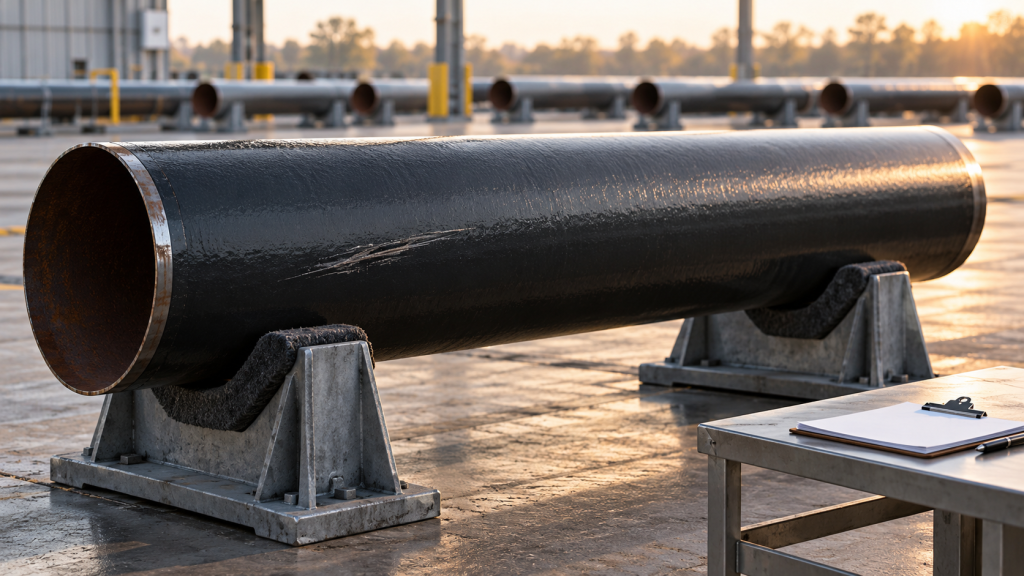




When buried pipeline coating becomes visible during authorized work, the first record can matter long after the surface is cleaned and recoated. A finished repair photograph shows the final appearance. It cannot recreate the original coating edge, the location of visible corrosion or the limits of the area that could actually be examined.
Plan that initial record as part of the operator’s inspection process. This article focuses on documentation and decision handoffs for pipelines within the relevant U.S. Part 195 requirements. It is not an excavation, testing, coating-removal or repair procedure. Access and work must follow the operator’s authorized safety and integrity procedures.
Recognize the exposed-pipe inspection checkpoint
49 CFR 195.569 requires examination for external corrosion when the operator knows that buried pipe is exposed and the pipe is bare or its coating is deteriorated. If external corrosion requires corrective action under section 195.585, the rule also requires investigation beyond the exposed portion, circumferentially and longitudinally, to determine whether additional corrosion needing remedial action exists nearby.
That distinction belongs in the work package. A coating concern may lead to an integrity investigation whose scope is larger than the visible opening. Have the operator’s responsible personnel determine the required examination and any further investigation; do not let the size of a planned coating patch decide that scope.
Agree on the initial-condition record before disturbance
At the planning stage, identify who will record the condition, who will review it and when that record must be captured. Arrange safe access through the approved work plan. Documentation must never delay an emergency response or require someone to enter an unsafe excavation.
A practical record structure can include:
- The operator’s asset and work-order identifiers, plus the location reference used by the integrity team.
- Date, observer and the reason the pipe became exposed.
- The extent of the area visible at that stage, with inaccessible portions identified.
- Overview and closer photographs linked to the same location and orientation.
- Observed coating condition, visible metal condition and any uncertainty requiring review.
Use descriptions that separate observation from interpretation. “Loose coating edge visible at the photographed location” records a condition. “Installation failure” assigns a cause that the photograph alone may not establish. If the coating identity is uncertain, preserve that uncertainty rather than guessing from its color.
Keep the coating decision separate from the pipe decision
Section 195.585 addresses corrective action for general corrosion and localized corrosion pitting. Its decisions depend on remaining wall condition, serviceability and the applicable engineering basis. A corrosion-control coating is not, merely by being applied, evidence that a corroded pipe meets those requirements.
Use separate status entries for the integrity assessment and the coating work. A contractor may have completed the specified coating operation while another required review remains open. The record should make that visible rather than allowing a broad “repair complete” label to close unrelated questions.
For example, a coordinator can ask whether the integrity team has issued its disposition and whether the coating inspector has accepted the coating work. Those are two distinct handoffs. The coordinator should record the authorized decisions, not substitute a personal interpretation of photographs or readings.
Link the stages without overwriting the first evidence
As the approved work proceeds, connect the initial condition, examination results, disposition and subsequent coating records under a consistent reference. Retain the original photographs. Add later views as later views, with captions that say what stage they show.
A simple sequence index might identify “initial exposed condition,” “examination record,” “approved disposition” and “completed coating inspection.” It is an organizational aid, not a prescribed technical sequence. The operator’s procedures determine the actual work and hold points.
Where new findings change the scope, record the revision and the person responsible for the decision. Avoid a final folder containing only the latest drawing and a collection of uncaptained images. A future reviewer needs to understand why the work changed as well as what was finally completed.
Assign the archive and retention requirement
Section 195.589(c) requires sufficiently detailed corrosion-control records and specifically requires records related to section 195.569 to remain for as long as the pipeline is in service. Do not apply a routine short-term project-folder deletion date without checking the applicable record class.
Confirm the archive owner, access arrangements and the reference that connects the record to the asset. The site’s coating handover guide offers a broader framework for keeping application and inspection evidence usable.
The goal is a clear history: what was exposed, what was observed, what the qualified team decided and how the work was closed. Preserving that history helps the next assessment start from evidence rather than from a finished surface and someone’s recollection.