Corrosion Under Insulation

Corrosion Under Insulation: Detection, Cost, and Coating Response

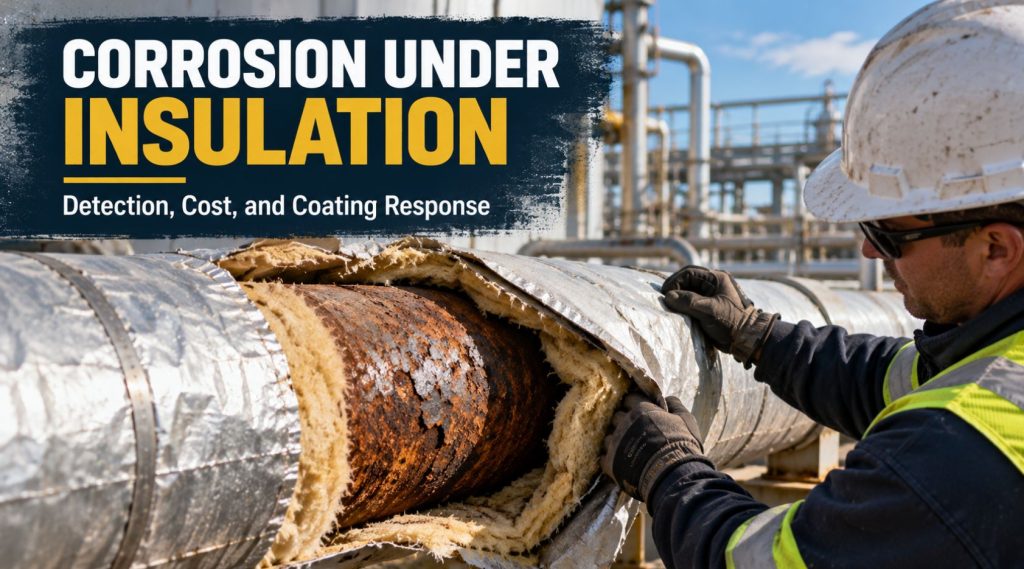
There’s a particular kind of dread that comes with pulling insulation off a pipe that’s supposedly been fine for years and finding the wall thinned down to almost nothing underneath. Corrosion under insulation, usually just called CUI in the industry, earns its reputation as one of the most frustrating asset integrity problems in oil and gas specifically because it happens completely out of sight, often for years, while every visual inspection of the insulated exterior looks perfectly normal.

This piece gets into why CUI happens, why it’s so hard to catch early, what detection actually looks like in practice, and where coating strategy fits into managing a problem that a lot of operators only take seriously after it’s already cost them a shutdown or a near-miss.

Why Insulated Pipe Is Uniquely Vulnerable

Insulation exists to control temperature, keeping hot process lines hot and cold lines cold, and it does that job well. What it also does, almost as a side effect, is create a sealed, dark, often damp environment against the pipe wall that’s close to ideal for corrosion once moisture finds a way in. Rain, wash-down water, condensation from temperature cycling, or a failed vapor barrier can all introduce moisture under an insulation jacket, and once it’s in there, it tends to stay in there, held against the metal surface by the same jacketing that’s supposed to be protecting the pipe.

The temperature range that makes CUI worst isn’t the extremes you’d intuitively expect. Pipe operating consistently very hot tends to stay dry enough underneath that moisture doesn’t linger, and pipe running consistently well below freezing has its own separate set of problems but doesn’t typically see the same corrosion mechanism. It’s the range in between, roughly the band where water can exist as a liquid and cycle between wet and dry, that creates the most persistent corrosion risk. Equipment that cycles between operating and idle, or between different process temperatures, tends to be particularly susceptible, since that cycling actively promotes condensation rather than letting things stay reliably dry or reliably frozen.

Why It’s So Hard to Catch

A visual inspection of insulated piping tells you almost nothing about what’s happening underneath the jacket. The insulation and cladding look fine. The pipe could be fine too, or it could be losing wall thickness at a rate that will lead to a leak within a defined timeframe, and there’s no way to know which from the outside without actually doing something to look underneath or through the insulation.

This is exactly why CUI has a reputation for showing up as a surprise, even at facilities with otherwise solid inspection programs. A piping system might get a thorough external visual inspection every turnaround cycle, checks that catch plenty of real problems on uninsulated equipment, while insulated sections quietly deteriorate underneath jacketing that hasn’t been opened up in years because nothing about it looked concerning from outside.

What Actual Detection Looks Like

A handful of methods have become standard for finding CUI without simply removing every foot of insulation on a facility, which would be prohibitively expensive and disruptive.

Visual inspection with strategic insulation removal remains a baseline approach, focused on areas known to be higher risk, insulation seams, low points where water can collect, areas near penetrations or supports where jacketing is more likely to have failed.

Infrared thermography scans the insulation’s exterior surface for temperature anomalies that can indicate wet insulation underneath, since wet insulation typically has different thermal properties than dry insulation. It’s a useful screening tool for covering large areas relatively quickly, though it doesn’t directly measure corrosion, it flags areas worth a closer look.

Guided wave ultrasonic testing sends a sound wave along a length of pipe and analyzes the return signal for indications of wall loss, allowing inspection of a significant pipe length from a single access point without removing insulation along the entire run. It’s particularly useful for screening long insulated runs to prioritize where more detailed inspection is actually needed.

Real-time radiography and pulsed eddy current testing both allow direct measurement of pipe wall condition through the insulation without removal, each with different tradeoffs in terms of cost, speed, and the specific conditions they work best under.

No single method catches everything reliably on its own, which is why a serious CUI management program typically combines a risk-based approach, focusing detailed inspection resources on the piping most likely to have a problem, with a mix of these detection methods rather than relying on just one.

The Cost Side of the Problem

CUI has a well-documented reputation across the industry as one of the more expensive corrosion mechanisms to manage, not just because of the direct cost of failures when they happen, but because of how much it costs to inspect for proactively across a large facility with miles of insulated piping. Unplanned shutdowns from a CUI-related leak carry costs well beyond the repair itself, lost production, potential environmental or safety consequences, and the kind of reputational damage that follows a preventable failure becoming public.

This cost reality is part of why risk-based inspection approaches have become standard practice rather than trying to inspect every insulated pipe segment on an equal footing. Prioritizing based on known risk factors, operating temperature range, insulation condition, history of moisture ingress, age of the system, gets more value out of limited inspection budgets than a uniform approach would.

Where Coating Strategy Fits

Coating choice matters both for new construction and for CUI mitigation on existing systems, and the goals are somewhat different from typical external pipeline coating decisions covered elsewhere on this site. A coating intended to sit under insulation needs to handle sustained, cyclical moisture exposure in a confined space, along with the specific temperature range the equipment operates in, and ideally provide enough of a barrier that even if moisture does get past the insulation and jacketing, it doesn’t immediately start attacking bare metal.

Surface preparation before applying any CUI-resistant coating matters just as much here as it does for any other pipeline coating application, arguably more, since a coating failure under insulation won’t be visually obvious the way an external coating failure often is. Our guide on properly preparing a pipeline surface before coating covers preparation standards that apply directly to insulated piping systems as much as any exposed application.

It’s worth being clear that cathodic protection, a mainstay of buried pipeline corrosion control, generally doesn’t function the same way for insulated above-ground piping the way it does for buried systems, since CP relies on electrical continuity through the surrounding soil or water that insulated, above-grade piping doesn’t have. Our explainer on how cathodic protection interacts with pipeline coatings covers where CP genuinely applies and where a coating has to carry the corrosion protection burden on its own instead.

Building a CUI Management Program

Facilities that manage this problem well tend to treat it as an ongoing program rather than a one-time coating decision at construction. That means maintaining an accurate inventory of insulated piping with associated risk factors, scheduling risk-based inspection using the detection methods that fit each segment’s risk level and access constraints, and having a clear protocol for what happens once a problem area is found, whether that’s targeted insulation removal for closer inspection, recoating, or in more severe cases, pipe replacement.

Understanding why coatings fail in general terms helps inform what to watch for specifically in a CUI context too. Our root cause analysis of pipeline coating failures covers failure patterns that show up across pipeline coating applications broadly, many of which apply directly to why a coating under insulation might not be performing as expected. For the broader corrosion prevention picture that CUI fits into alongside other mechanisms, our complete guide to pipeline corrosion prevention covers the full toolkit operators draw from, coatings, cathodic protection, soil chemistry, and inspection technology working together rather than any single method carrying the whole burden.

Things to Consider for a CUI Program

  1. Has the facility’s insulated piping inventory actually been risk-ranked, or is inspection happening on a uniform schedule regardless of actual risk factors?
  2. Are detection methods matched to each segment’s access constraints and risk level, rather than defaulting to a single method across the whole facility?
  3. Has coating specification for insulated service actually accounted for the specific moisture and temperature cycling conditions, rather than reusing a standard external pipeline coating spec?
  4. Is there a documented protocol for what happens once a problem area is identified, so a finding doesn’t sit unaddressed while a decision gets made?
  5. Are insulation jacketing seals and vapor barriers being inspected and maintained, since preventing moisture ingress in the first place is at least as important as detecting corrosion after it’s already started?

Frequently Asked Questions

What temperature range is most susceptible to corrosion under insulation?

The range where moisture can exist as a liquid and cycle between wet and dry conditions tends to be the most problematic, rather than extreme high or low operating temperatures where conditions stay more consistently dry or frozen.

Can corrosion under insulation be detected without removing the insulation?

Yes, to a significant degree. Infrared thermography, guided wave ultrasonic testing, real-time radiography, and pulsed eddy current testing can all provide useful information without full insulation removal, though targeted removal for direct visual inspection is still often part of a complete program.

Does cathodic protection prevent corrosion under insulation?

Generally not for above-ground insulated piping, since cathodic protection relies on electrical continuity through soil or water that insulated, above-grade systems don’t have. Coating strategy carries more of the corrosion protection responsibility in these applications.

Why is corrosion under insulation considered so costly to manage?

Both the direct cost of failures, including unplanned shutdowns and potential safety or environmental consequences, and the cost of proactive inspection across large facilities with extensive insulated piping contribute to CUI’s reputation as an expensive corrosion mechanism to manage well.

How often should insulated piping be inspected for CUI?

It depends on risk factors specific to each piping segment, operating temperature range, insulation and jacketing condition, moisture exposure history, rather than a single fixed interval applied uniformly across a facility.

Conclusion

Corrosion under insulation is a genuinely difficult problem precisely because it hides so well, and facilities that treat it as an afterthought behind more visible corrosion concerns tend to find out the hard way that it doesn’t stay hidden forever. Building a real risk-based inspection program, choosing coating systems actually suited to the moisture and temperature conditions under insulation rather than reusing a standard external spec, and maintaining the insulation jacketing itself to keep moisture out in the first place are what separate facilities that manage this problem proactively from ones that discover it during an unplanned shutdown.

Read More
tank farm coating maintenance

Tank Farm Coating Maintenance: Inspection Cycles and Recoat Windows

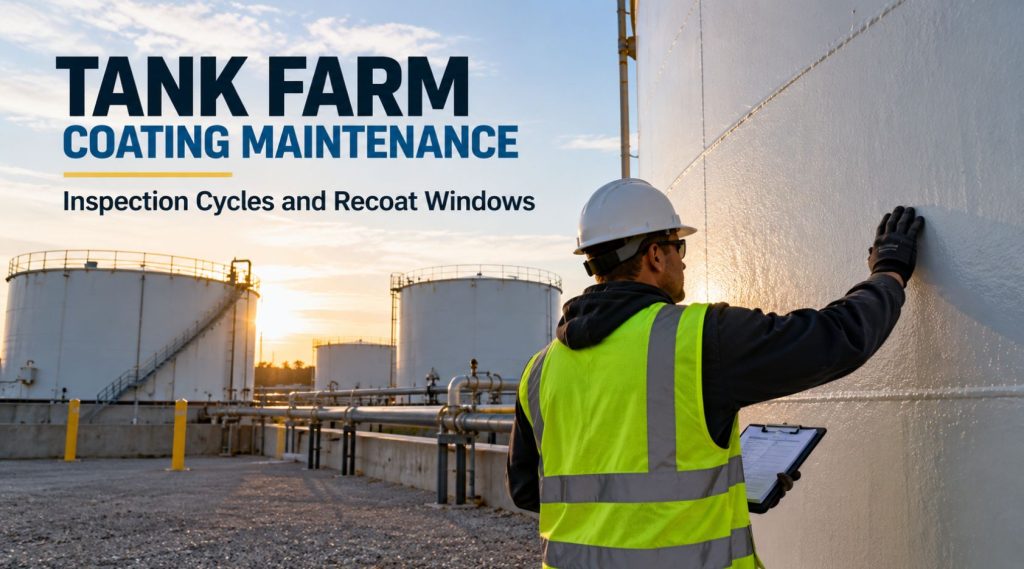
Tank farm coating maintenance is the ongoing program of inspection, condition assessment, and recoating that keeps tank shells, floors, roofs, and the surrounding containment structures protected against corrosion over decades of service. It’s a different discipline than new construction coating work. A new tank gets coated once, under controlled conditions, before it ever holds product. A tank that’s been in service for fifteen years gets coated under a completely different set of constraints: partial shutdowns, existing coating that has to be assessed and sometimes removed, and a decision every time about whether a section needs a full recoat or just a targeted repair. Getting that program right is what separates a tank farm that avoids surprise failures from one that’s constantly reacting to them.

What a Coating Maintenance Program Actually Covers

A tank farm isn’t one surface. It’s several, and each one ages differently. The exterior shell faces weather and UV exposure and typically gets a topcoat refresh well before the underlying system needs full replacement. The roof, especially on a cone or dome roof tank, sees standing water and thermal cycling that wears coatings faster than the vertical shell does. The internal lining, where product actually contacts the tank, deals with chemical exposure that varies enormously depending on what’s stored, from relatively benign refined products to more aggressive crude blends with higher water and sediment content. And the tank floor, sitting where water and sediment settle out of stored product, is often the first place internal corrosion shows up, which is exactly why floor coating and inspection get their own dedicated attention in most maintenance programs.

Then there’s everything around the tank itself: containment berms, interconnecting piping, and any secondary containment liner system, all of which need their own inspection and maintenance rhythm even though they’re not technically part of the tank.

Building an Inspection Cycle That Actually Catches Problems

Inspection frequency isn’t arbitrary. For aboveground storage tanks, API 653 sets the framework most operators use to determine internal inspection intervals, based on corrosion rate calculations tied to the tank’s minimum required thickness and the actual corrosion rate measured during the last inspection. A tank with a low measured corrosion rate might go fifteen or twenty years between internal inspections. A tank with active, faster corrosion gets inspected far more often, sometimes on a much shorter cycle if the numbers say so.

External visual inspection happens on a much tighter schedule than that, often annually or more frequently depending on the operator’s risk management approach. This is where a lot of coating problems get caught early: chalking, blistering, rust bleed at seams or fasteners, and general film breakdown are all visible from the outside without taking the tank out of service.

Risk-based inspection approaches have become more common across the industry, adjusting inspection frequency based on the actual consequence of a failure, not just a fixed calendar interval. A tank holding a relatively low-risk product in a location with minimal environmental sensitivity might reasonably be inspected less often than a tank holding something more hazardous in a location where a release would be far more consequential. The inspection cycle should reflect that risk picture, not just apply the same interval across every tank on the farm regardless of what’s actually at stake.

What Actually Triggers a Recoat

Not every coating defect means the whole tank needs to be stripped and recoated. Knowing the difference between a spot repair and a full recoat situation saves real money, but getting that call wrong in either direction creates its own problems.

A few signals tend to point toward a full recoat rather than a patch job. Widespread film breakdown across a large percentage of the surface, rather than isolated defects, usually means the coating system as a whole has reached the end of its useful life. Adhesion loss detected through testing, not just visible peeling, suggests the bond between coating and substrate has broken down more broadly than what’s visible on the surface. And coating age relative to the manufacturer’s expected service life matters too: a coating well past its rated life that’s showing any meaningful degradation is a different situation than a coating still well within its expected window with a single localized defect.

Holiday testing, checking for pinholes or thin spots using a high voltage spark tester on thicker coatings or a low voltage wet sponge method on thinner linings, is standard practice on internal linings before a tank goes back into service after any coating work. It catches defects that wouldn’t necessarily be visible otherwise, and a lining with widespread holidays across a large area is usually telling you the same thing as widespread visible film breakdown: the system needs full replacement, not spot repair.

Full Recoat vs. Spot Repair

FactorSpot RepairFull Recoat
Extent of defectsIsolated, limited areaWidespread across the surface
Adhesion conditionGood in surrounding areasCompromised broadly
Coating age vs. service lifeWell within expected lifeAt or past expected service life
CostLower, targetedHigher, full surface preparation and application
DowntimeMinimal, often no shutdown neededOften requires tank out of service
Long-term outlookBuys time on an otherwise sound systemResets the service life clock

The decision usually comes down to whether the underlying coating system is still fundamentally sound with a few isolated problems, or whether the problems reflect a system that’s genuinely reached the end of its service life. Patching a tank that needs a full recoat just delays an inevitable, larger job, often at a point where the substrate has taken on more corrosion damage than it would have with a timely full recoat.

Standards and Regulatory Context

API 653 governs inspection, repair, alteration, and reconstruction of aboveground storage tanks and is the primary reference most operators work from for internal inspection intervals and repair criteria. Surface preparation for any recoat work should follow the applicable SSPC or NACE standard specified for the coating system being applied, and that standard should come from the coating manufacturer’s technical documentation for the specific product, not a generic assumption carried over from a different job.

Where a tank sits within a facility subject to SPCC requirements under 40 CFR 112, the condition of secondary containment around the tank is part of the same overall compliance picture, even though it’s a separate physical system from the tank coating itself. Our guide on well pad containment systems covers spray-applied, panel, and liner containment approaches in more depth, and a lot of the same inspection discipline that applies to tank coatings applies to the containment system surrounding it.

Coverage and Planning for Recoat Work

For spray-applied recoat systems, material planning follows the same basic coverage math used across the industry: one gallon spread at one mil thickness covers 1,604 square feet. Actual coverage for a specific recoat job depends on the dry film thickness specified for that coating system, which should come from the manufacturer’s technical data sheet rather than a generic assumption, particularly since recoat film builds sometimes differ from new construction specifications depending on the condition of the existing surface.

Recordkeeping and Tracking Coating History

A coating maintenance program is only as good as the records behind it. Every inspection should generate a documented record: coating condition ratings, film thickness readings, adhesion test results where applicable, photographs of any defects, and the specific findings that drove any repair or recoat decision. Without that history, each new inspection starts from scratch, and patterns that would otherwise be obvious over time, a section of tank that keeps failing early, a coating system that consistently underperforms its rated service life in a particular environment, go unnoticed.

Many operators managing larger tank farms have moved toward digital asset management systems that tie coating history directly to each tank’s inspection record, sometimes integrated with the broader mechanical integrity program covering the tank itself. That level of system isn’t necessary for every operation, but even a straightforward spreadsheet tracking coating type, application date, last inspection date, and condition findings per tank gives a maintenance program something to plan against instead of reacting to whatever surfaces during the next scheduled inspection. The goal either way is the same: turning individual inspection events into a continuous record that actually informs decisions, rather than treating each inspection as an isolated data point disconnected from the tank’s coating history.

Common Mistakes in Tank Farm Coating Programs

Deferring inspection to save near-term cost is probably the most common mistake, and it’s also the most expensive one over time. A corrosion problem caught early is a coating job. The same problem caught late can mean structural repair, and in the worst cases, a release.

Spot-repairing a system that actually needs full replacement is another recurring issue. It’s understandable why it happens: a spot repair is cheaper and faster in the moment. But when the underlying coating system has reached the end of its service life, repeated spot repairs on a failing system tend to cost more in cumulative labor and downtime than a single, well-planned full recoat would have.

Poor recordkeeping causes its own problems. Without a documented history of inspection findings, coating age, and past repair work, it’s hard to make a good data-driven decision about what a tank actually needs versus relying on whatever the inspector happens to notice that day. A tank farm with solid historical records can plan recoat work proactively. One without them ends up making reactive decisions under time pressure.

And mismatching a recoat product to the original system is a mistake that’s easy to make and expensive to fix. Not every coating chemistry is compatible with every existing substrate or prior coating layer, and applying an incompatible system can cause adhesion failure that shows up faster than the original coating problem did.

Frequently Asked Questions

How often should tank farm coatings be inspected? 

External visual inspection typically happens annually or more often, while internal inspection intervals are generally set using API 653 corrosion rate calculations and can range from a few years to two decades depending on measured corrosion rates and tank service.

What’s the difference between a spot repair and a full recoat? 

A spot repair addresses isolated defects on an otherwise sound coating system. A full recoat replaces the entire system, typically because degradation is widespread, adhesion has broadly failed, or the coating has reached the end of its expected service life.

What is API 653 and why does it matter for coating maintenance? 

API 653 is the industry standard governing inspection, repair, alteration, and reconstruction of aboveground storage tanks. It’s the primary reference for setting internal inspection intervals based on corrosion rate and tank condition.

Can a tank stay in service during coating maintenance? 

External shell and roof work can often be done with the tank in service, depending on the scope. Internal lining work, including most floor recoating, generally requires the tank to be taken out of service and properly cleaned and vented first.

How long does a tank coating typically last before it needs a recoat? 

This depends heavily on the specific coating system, the product stored, and environmental exposure. The manufacturer’s technical documentation for the specific coating gives the expected service life, and actual condition at inspection should always take priority over a generic assumption based on age alone.

Who typically manages a tank farm coating maintenance program? 

It’s usually a shared responsibility between the facility’s mechanical integrity or asset management team, who track inspection schedules and regulatory compliance, and the coating contractor or applicator brought in for the actual assessment and recoat work. Larger operations often have an internal coordinator whose job is specifically to keep the inspection calendar, recordkeeping, and contractor scheduling aligned across every tank on the site.

Conclusion

A tank farm coating maintenance program that actually works isn’t built around a single fixed schedule applied to every tank the same way. It’s built around inspection intervals grounded in real corrosion data, a clear framework for deciding when a spot repair is enough versus when a full recoat is the right call, and consistent recordkeeping that turns each inspection into useful data for the next one. Operators who treat coating maintenance as an ongoing program rather than a reactive response to visible problems consistently spend less over the life of a tank farm, and they avoid the kind of surprise failures that cost far more than the maintenance program ever would have.

Read More