
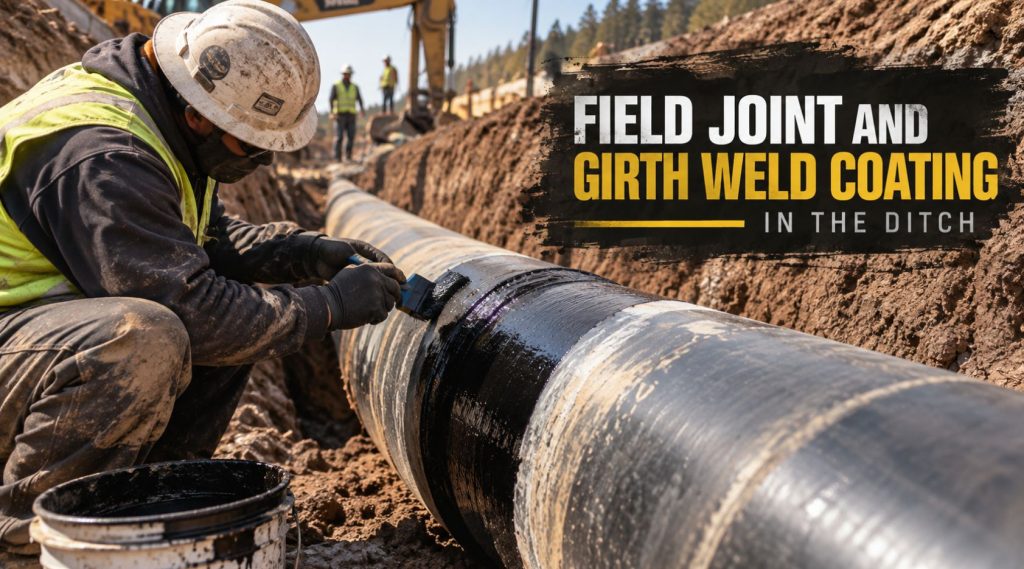
There’s a moment on almost every pipeline construction spread where the mainline coating stops mattering for a second, and everyone’s attention shifts to a six-inch band of bare steel sitting in a trench. That band is the girth weld, the spot where two lengths of factory-coated pipe were joined in the field, and it’s the one piece of the entire pipeline that never saw a coating plant. Everything else on the line got its protection under controlled conditions, heated, cleaned, and cured indoors. The girth weld gets coated outside, in whatever weather shows up that day, by a crew working against a schedule that doesn’t care much about humidity or wind.
That’s the whole story of pipeline girth weld coating in one sentence: it’s the best coating system in the world applied under the worst conditions the job can throw at it. Get it right and nobody ever thinks about that joint again for forty years. Get it wrong and you’ve built a corrosion initiation site into a pipeline that otherwise had every reason to perform.
This piece walks through what actually happens at the ditch when a field joint gets coated, why the process deserves more attention than it usually gets, and what separates a joint that holds up from one that becomes tomorrow’s excavation.
Why the Girth Weld Is the Weak Link in the System
Mainline pipe typically arrives at the spread with a factory-applied coating already in place, whether that’s fusion bonded epoxy, a three-layer polyethylene system, or another mill-applied product. That coating went on in a plant with consistent surface prep, controlled temperature, and quality checks built into the line. None of that exists at a field joint. The weld itself has to stay bare until it’s welded, x-rayed, and accepted, which means every girth weld arrives at coating time as an isolated patch of uncoated steel sitting between two coated sections, usually somewhere between four and twelve inches wide depending on cutback length and pipe diameter.
That gap has to be bridged with a coating applied on-site, and it has to bond not just to bare steel but to the cut edge of the existing mill coating on either side, a transition zone that’s a common origin point for disbondment if it isn’t handled correctly. Add in the fact that this work often happens in a trench, sometimes below grade, sometimes with groundwater intruding, sometimes in weather nobody would choose for a coating job if the schedule allowed for waiting, and it becomes clear why field joints show up disproportionately often in pipeline failure investigations relative to the small fraction of total pipe surface they represent.
What “In the Ditch” Actually Changes
A lot of technical literature on pipeline coating reads as if every application happens on a clean, dry, temperature-controlled surface. Field joint coating rarely gets that luxury. Working in the ditch means the crew is often coating below the surrounding grade, sometimes with limited headroom to maneuver blasting or spray equipment around the pipe, and frequently on a compressed timeline because the trench can’t stay open indefinitely once tie-in welding is complete.
Weather is the other variable that separates ditch work from shop work. Rain, wind-driven dust, and temperature swings between morning and afternoon all affect surface preparation quality and coating cure in ways a coating plant simply doesn’t have to manage. A crew that would happily wait out a dust storm on a controlled job often can’t afford to on a linear construction spread moving at a set number of joints per day. That production pressure is real, and it’s exactly why field joint coating procedures need to be specific, repeatable, and resistant to being shortcut when the day is running long.
Surface Preparation at the Joint Comes First, Every Time
Nothing about field joint coating matters if the surface prep underneath it is inadequate, and that’s true across every coating type on this site, not just field joints specifically. Our guide on properly preparing a pipeline surface before coating lays out the abrasive blast standards that apply here, and at a girth weld the requirement is usually stricter than what a lot of crews expect, because the joint is carrying the full corrosion-protection burden with no mill coating underneath to fall back on.
Near-white metal blast per NACE No. 2 / SSPC-SP 10 is the typical baseline for buried spray-applied field joint coatings, with an anchor profile in the 2.5 to 4.5 mil range depending on the specific product’s technical data sheet. The bare steel band needs full profile, but so does the transition zone where the new coating overlaps the cut edge of the factory coating, and that overlap area gets missed more often than it should. A rushed feathering or bevel on the mill coat edge leaves a step that the field joint material has to bridge, and a poor bridge there is one of the more common places disbondment actually starts. Weld spatter, arc strikes, and any residual welding slag also need to be fully removed before blasting, since coating over any of that essentially guarantees a defect at that exact spot.
Coating Options for Field Joints
Three broad categories cover most field joint work, and the right one depends on the pipe’s mainline coating, the service environment, and how much time the crew realistically has at each joint.
Heat-shrink sleeves remain common for field joints paired with FBE or three-layer mainline coatings, using a radiation-crosslinked polyethylene backing with a hot-melt adhesive that bonds to the pipe and the mill coating edges once heated. They’re relatively fast to install and don’t require spray equipment, which is part of their appeal on remote spreads, but installation quality is entirely dependent on getting the heat and pressure right, and improperly shrunk sleeves are a well-documented source of tenting and voids.
Liquid epoxy and two-part liquid coatings get applied by brush, roller, or low-pressure spray directly onto the prepared joint, curing over a period of hours rather than seconds. They’re a reasonable option for irregular joint geometry or repair situations, though cure time on a cold or wet day can stretch out in ways that hold up the whole crew behind that joint.
Spray-applied polyurea and polyurethane systems have become the fastest-growing choice for field joints specifically because they solve the production-rate problem. Gel times under five seconds mean a joint can be coated and ready to backfill in a fraction of the time a liquid epoxy needs to cure, without sacrificing the flexibility that a rigid coating lacks. Our guide on why polyurea has become the go-to pipeline coating covers the underlying chemistry, and the same properties that make it attractive on rehab work, fast cure, high elongation, strong adhesion to properly prepped steel, are exactly what a field joint crew needs when the ditch can’t stay open all week.
| Field Joint System | Typical Cure/Set Time | Equipment Needed | Best Fit | Watch-Out |
|---|---|---|---|---|
| Heat-shrink sleeve | Minutes (heat-activated) | Propane torch, rollers | FBE or 3LPE mainline, moderate soils | Improper heat/pressure causes tenting |
| Liquid epoxy | Hours | Brush/roller/low-pressure spray | Irregular geometry, repairs | Slow cure holds up backfill schedule |
| Spray polyurea/polyurethane | Seconds to minutes | Plural-component spray rig | High-production spreads, HDD tie-ins, aggressive soils | Requires trained applicator and proper equipment maintenance |
For a broader comparison of how these categories stack up against factory-applied mainline systems, our guide on pipeline coating systems compared, FBE, tape, and spray-applied goes into more depth on where each one fits across the full pipeline lifecycle, not just at the joint.
Thickness and Holiday Testing Don’t Get a Pass at the Joint
It’s tempting to treat the field joint as a smaller version of the mainline spec, but thickness requirements at the joint are often driven by different considerations, mechanical protection during backfill, soil stress at a point where pipe stiffness changes slightly, and the fact that the joint has no factory coating to share the load with. Our detailed breakdown of polyurea coating thickness for pipeline service explains the relationship between dry film thickness and holiday frequency, and that relationship matters even more at a field joint, where a single missed spot in a narrow coated band represents a much larger share of the total protected surface than a comparable holiday would on hundreds of feet of mainline pipe.
Holiday testing every joint before backfill isn’t optional on a well-run spread, even though it slows the crew down slightly. A high-voltage spark tester calibrated to the coating’s specified thickness catches pinholes and thin spots that visual inspection alone will miss, and catching them before the trench closes is immeasurably cheaper than catching them during an integrity dig fifteen years later.
Cathodic Protection Has to See the Joint, Too
A pipeline’s cathodic protection system is designed around the assumption that the coating is doing most of the corrosion-prevention work, with CP picking up the small percentage of area where coating defects exist. Field joints complicate that picture slightly, since they’re a known, concentrated area where coating quality varies more than it does on mill-coated pipe. Our explainer on how cathodic protection interacts with pipeline coatings covers this relationship in more general terms, but the practical takeaway for field joints specifically is that CP effectiveness at a disbonded or holidayed joint depends heavily on electrical continuity through the surrounding soil, which isn’t guaranteed at every joint location, particularly in rocky ditch conditions or where backfill material varies from the rest of the right-of-way.
Where Field Joints Actually Fail
Nearly every root cause behind a failed field joint traces back to one of a handful of repeatable issues rather than something exotic. Our root cause analysis of pipeline coating failures covers the broader failure landscape across coating types, and field joints show up disproportionately in that data for reasons that are almost always preventable at the time of installation.
Inadequate surface preparation, especially at the transition zone with the mill coating, is the single most common thread. Moisture on the steel at the time of application, whether from rain, condensation, or a joint coated too soon after a weld cooled in humid conditions, is close behind. Rushed cure time on liquid systems, where a crew backfills before the coating has actually reached handling strength, causes mechanical damage that isn’t visible until the joint is excavated years later. And mismatched coating chemistry, where a field joint product isn’t actually compatible with the mainline coating it’s supposed to bond to, creates an adhesion problem baked into the joint from day one.
Things to Consider Before Specifying a Field Joint Coating System
- What’s the mainline coating, and has the field joint product actually been tested and approved for adhesion compatibility with it?
- What production rate does the spread need per day, and does the coating’s cure time realistically support that schedule without cutting corners?
- What are the actual ditch conditions, moisture, temperature range, and access constraints, at the time of year construction is planned?
- Is holiday testing built into the daily workflow before backfill, or is it something that happens only when someone remembers?
- Does the transition zone at the mill coating cut edge get its own inspection step, separate from checking the bare-steel band?
Frequently Asked Questions
What is a girth weld field joint in pipeline construction?
It’s the section of bare pipe left uncoated at the factory so the joint can be welded in the field once two pipe sections are aligned. Once the weld is completed and inspected, that band of bare steel and the adjacent cut edges of the mill coating need their own coating applied on-site before backfill.
Why can’t field joints just use the same coating as the rest of the pipe?
Mainline coatings like FBE or 3LPE are applied under factory conditions that can’t be replicated in a trench. Field joint coatings are formulated and selected specifically for field application, often prioritizing fast cure and forgiving application conditions over the exact chemistry used at the mill.
How thick should a field joint coating be?
It depends on the coating system and soil conditions, but spray-applied field joint systems commonly run in a similar range to mainline polyurea specs, with aggressive soils or rocky backfill pushing toward the higher end of typical thickness ranges. The coating manufacturer’s technical data sheet should always be the final word for a specific product.
Does weather actually affect field joint coating quality?
Yes, significantly. Moisture on the steel surface, wind-blown dust re-contaminating a blasted surface, and temperature extremes affecting cure time all have a measurable effect on field joint performance, which is part of why procedures often specify minimum and maximum application temperatures and require protection from precipitation during application.
How is a field joint coating inspected before backfill?
Visual inspection, dry film thickness measurement, and holiday testing with a properly calibrated spark tester are standard steps. Adhesion testing is sometimes specified for a sample percentage of joints, particularly on larger projects or where a new applicator crew is being qualified on the job.
Conclusion
Every pipeline is only as strong as its weakest coated section, and on most projects, that weakest section is sitting in the ditch at a girth weld rather than anywhere along the factory-coated mainline. The coating going onto that joint has to do everything the mill coating does, bond to bare steel, resist soil stress, hold up cathodic protection continuity, without any of the controlled conditions that made the mill coating reliable in the first place. Treating field joint coating as a rushed afterthought behind the more visible work of welding and tie-in is one of the more common ways operators end up funding an unplanned dig years down the line. Getting surface prep right at the transition zone, matching the coating system to the mainline chemistry and the actual ditch conditions, and holiday-testing every joint before backfill are what separate a field joint that quietly does its job for decades from one that becomes the reason a crew is back out on the right-of-way sooner than anyone planned.